

I have created a number blogs to publish useful information. One is a Teaching Blog dedicated to providing past, present and future students useful information.
My Research Blog is dedicated to disseminating useful information to other researchers and scholars.
A new blog is focused on how to improve forecasts, which is a key strategic skill: forecasting-strategy.ch
To track progress in machine learning, I also run an AI blog.
There is also a blog that has collected all of Charles Tilly’s Writings on Methodology.
Below you find every entry across all my Blogs.
Posted by Johann Peter Murmann

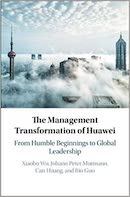
The Management Transformation of Huawei: From Humble Beginnings to Global Leadership
Huawei has become China’s most prominent multinational company and a leader in the ICT sector. Given unprecedented access to the company, the authors of this book examine the management transformation of Huawei from its inception in 1987 until 2019, observing in detail not only the creation of its organizational routines but also the breaking of routines across most major functional areas: Management, Product Development, HR, Supply Chain, Finance, R&D, Intellectual Property, and International Business. ‘Dynamic capabilities’ are central to theories of competitive advantage and this book highlights Huawei as an ideal case study for the successful implementation of change routines and change-supporting values. The chapters cover all the major change initiatives the firm has undertaken since 1996 to import best practices from the West, with the help of consultants. The insights presented in the book will be particularly interesting for academics in the field of strategy, management, and business history.
Table of Contents and ordering

Endorsements
‘This is a ‘must read’ book for whoever is interested in the rise of China. It provides unique empirical and conceptual insights on China’s leading company and draws on world class researchers for analysis and commentaries. Uniquely valuable!’
—Yves Doz, Solvay Chaired Professor of Technological Innovation, INSEAD
‘The Management Transformation of Huawei provides a fascinating account of how Huawei preserved its entrepreneurial spirit as it rapidly scaled up over its 30-year history. Very few studies provide such an in-depth historical account of the evolution of a company over such a long period of time. Any scholar or practitioner interested in understanding the leadership challenges that arise with rapid organizational growth should read this book.’
—Ranjay Gulati, Paul R. Lawrence MBA Class of 1942 Professor of Business Administration, Harvard Business School
‘Huawei has become a major player in the global electronics industry and has been - perhaps unwantedly - cast into the role of a significant geopolitical force. This book is important and interesting because of the astonishing story of Huawei’s corporate growth. The authors provide an insightful account of how Huawei transformed itself from a small startup into a global giant, making an important scholarly contribution under major headings of the strategic management literature, such as ‘knowledge’, ‘routines’ and ‘dynamic capabilities’.’
—Sidney G. Winter, Deloitte and Touche Professor Emeritus of Management, Wharton School, University of Pennsylvania
Cambridge University Press Book page
Categories: Bookshelf | China | Innovation | Management | Publications | Writing |
Posted on Apr 07, 20

Striking Similarities to Spanish Flue outbreak in 1918
We have heard about the similarities of COVID-19 to the Spanish flue, but here is it told well in a short video.
Categories:
Posted on Mar 21, 20

Why gave hydrogen-powered car not become mainstream even though they were hyped in already in 1974
GM had a hydrogen-powered bus in 1967. VW and Mercedes had experimental hydrogen-powered cars in mid-1970s. Here is a list of vehicles produced by various companies. WSJ.com has produced a great video explaining why hydrogen cars are still not around the corner, despite the technology’s great promise.
Categories: Innovation | Management |
Posted on Jan 22, 20

VW CEO uses history to explain why VW needs to speed up change to avoid the fate of Nokia
This is a Deepl AI translation of the speech of VW CEO to employees in January 2029. The complete speech of the VW boss in the wording:
“Ladies and gentlemen,
the world is on the move. Politically and technologically, we live in an incredibly dynamic time. A turn of an era stands before us - from the dimension of the industrial revolution. And Volkswagen is in the midst of the storm of the two greatest transformation processes:
- Climate change and the associated pressure to innovate towards emission-free driving.
- And digitalisation, which is fundamentally changing the automobile as a product.
Our Group is not always in the best position to react quickly and systematically enough to these developments. Measured against this, we have not done badly so far. This is also acknowledged by market observers. In 2019 in particular, analysts have gained new confidence in our strategy.
At the beginning of this year, Kepler Cheuvreux attested: “We think VW is the best positioned player in the industry to master the CO2 challenge. And Goldman Sachs says: “We expect VW Group to continue to prosper this year as a result of ongoing positive sales developments at VW brand, a pick-up in sales at Audi, and broadly flat margins.
In the Litigation area, we are making the risks from the diesel crisis more manageable step by step. In terms of corporate culture, we are seeing tangible and measurable progress. I am pleased that we have increased our integrity by three points in the sentiment barometer.
Our modern MQB-based model range in terms of volume and the new Porsches, Audis, Lamborghinis and Bentleys are convincing customers. We are improving the quality of our business. Revenue and earnings are growing faster than unit sales. In China, we increased our market share by 1.4 percent in a sharply declining market. This is a great achievement, which hardly anyone would have expected from us. Congratulations to Stephan Wöllenstein and his team on their outstanding performance!
In South America we are back in the black for the first time, and we have also turned our business around in Russia. In North America, we have significantly improved our earnings and are aiming to break even this year. Volkswagen Financial Services will have a record year in 2019, and the component has taken decisive steps in battery development and production.
At Audi, the e-tron got off to a successful start, development costs were reduced and a comprehensive cost reduction programme was launched. Porsche has once again delivered excellent figures and cars and set an example with the Taycan. Seat conquers new and young customers with Cupra. Skoda is running at full speed and will present the new models in India, an important future market for us, at the beginning of February.
VW Commercial Vehicles has put the extremely important Ford cooperation on track, and Traton has completed its IPO. We are seeing positive trends at Bentley, Ducati, Bugatti and Lamborghini, and Bentley in particular is back in the black. The Volkswagen core brand has worked hard to further increase returns. All in all: good developments.
“The storm is just beginning”
Categories: Management |
Posted on Jan 21, 20

Framework and Toolkit for Improving Peripheral Strategic Vision
Day and Shoemaker have developed a useful framework and toolkit for assessing how much peripheral strategic vision your company needs.

An MIT Sloan article lays out the ideas in three steps.

More details on the toolkit are in their HBR article that can be assessed here.
Categories: Bookshelf | Management |
Posted on Jan 19, 20

The Innovation and Entrepreneurship Ecosystem in India
India began the process of market liberalization that opened it to significant interactions with the world economy in 1991. In this essay, we provide an overarching view of the country’s journey toward integration with the global innovation and entrepreneurship network. Major nodes in this global network have two major components that may be metaphorically referred to as ‘pillars and ivy’. Globally connected multinational enterprises (MNEs) form the pillars. Agile startups are the ivy, and their success (metaphorically, the height to which they can climb) depends on their symbiotic connections with the pillar MNEs. Both components are essential and reinforce each other. Without MNEs, the scaling of startups is hampered. Without a vibrant population of startups, MNEs’ interest in a location remains driven by cost, rather than capability and creativity. MNEs (mainly foreign) provided the initial sparks for the formation of the Indian innovation and entrepreneurship ecosystem. We chart the subsequent growth of India’s startups. They began in the information technology (IT) sector but now cover a much wider range of industries. Today, India’s innovation and entrepreneurship ecosystem is one of the largest in the world, with global integration in terms of technology, financing, human capital, and administration.
This is the introductory essay to a Special Issue of Management and Organization Review on The Innovation and Entrepreneurship Ecosystem in India.

Categories: Entrepreneurship | Innovation |
Posted on Jan 11, 20

On Strategic management, leadership & the success of Huawei
I did a four-minute interview with the HSG Focus Magazine.
Categories: Management | Publications |
Posted on Dec 22, 19

“We do not do PowerPoint at Amazon”
Jeff Bezos explains in an annual letter to shareholders that Amazon bans PowerPoint presentations.
Six-Page Narratives
We don’t do PowerPoint (or any other slide-oriented) presentations at Amazon. Instead, we write narratively structured six-page memos. We silently read one at the beginning of each meeting in a kind of “study hall.” Not surprisingly, the quality of these memos varies widely. Some have the clarity of angels singing. They are brilliant and thoughtful and set up the meeting for high-quality discussion. Sometimes they come in at the other end of the spectrum.
In the handstand example, it’s pretty straightforward to recognize high standards. It wouldn’t be difficult to lay out in detail the requirements of a well-executed handstand, and then you’re either doing it or you’re not. The writing example is very different. The difference between a great memo and an average one is much squishier. It would be extremely hard to write down the detailed requirements that make up a great memo. Nevertheless, I find that much of the time, readers react to great memos very similarly. They know it when they see it. The standard is there, and it is real, even if it’s not easily describable.
Here’s what we’ve figured out. Often, when a memo isn’t great, it’s not the writer’s inability to recognize the high standard, but instead a wrong expectation on scope: they mistakenly believe a high-standards, six-page memo can be written in one or two days or even a few hours, when really it might take a week or more! They’re trying to perfect a handstand in just two weeks, and we’re not coaching them right. The great memos are written and re-written, shared with colleagues who are asked to improve the work, set aside for a couple of days, and then edited again with a fresh mind. They simply can’t be done in a day or two. The key point here is that you can improve results through the simple act of teaching scope – that a great memo probably should take a week or more.
Source: Annual Report 2018

Categories: Management | Writing |
Posted on Nov 23, 19

US Big Business Lobby Group Updates Mission of the Public Corporation
Fortune Text accompanying this: The Business Roundtable Issues Updated Statement on the Purpose of a Corporation.
The Economist takes a more critical stance.
Categories: Gobal Strategy | Topics | Fundamental Objective | Strategic Management 1 | Topics | Fundamental Objective | Strategic Management 4 | Topics | Fundamental Objective | Strategy Implementation - 782 | Topics | Fundamental Objective |
Posted on Sep 07, 19

Curious First in the World: KLM airline wants its customers to fly less.
KLM wants its customers to fly less. What does this mean for what are KLM’s fundamental goals?
Categories: Gobal Strategy | Topics | Fundamental Objective | Strategic Management 1 | Topics | Fundamental Objective | Strategic Management 4 | Topics | Fundamental Objective | Strategy Implementation - 782 | Topics | Fundamental Objective |
Posted on Jul 12, 19

WEBA (Weaving Company Appenzell), Switzerland
This is an information video how WEBA (Weaving Company Appenzell), Switzerland, is able to produce high cloth for shirt fashion designers.
Categories: Gobal Strategy | Cases | Strategy Evolution: Historical Firm Cases | Firm Histories |
Posted on Jan 30, 19

Former Southwest Airlines CEO’s Personal Fundamental Objective
“Anybody who seeks wealth as an end in itself is always going to be disappointed,” he said in 1995. “What you really should be doing is seeking excellence in achievement.”
Source: Washington Post Obituary
Categories: Gobal Strategy | Topics | Fundamental Objective | Strategic Management 1 | Topics | Fundamental Objective | Strategic Management 4 | Topics | Fundamental Objective |
Posted on Jan 06, 19
History of St. Gallen’s Contribution to the Textile Industry

Categories: Strategy Evolution: Historical Firm Cases | Firm Histories |
Posted on Dec 22, 18
Eastern Switzerland Region from which to draw firms for histories.
Categories: Strategy Evolution: Historical Firm Cases | Course Outline |
Posted on Nov 21, 18

What Does the Success of Tesla Mean for the Future Dynamics in the Global Automobile Sector?
After reading Jacobides, MacDuffie, and Tae (2016), the success of Tesla in launching a new automobile company in a crowded sector puzzled us. Jacobides, MacDuffie, and Tae (2016) had convinced us that developing the capabilities to become the manufacturer of a complete, safe automobile system would be quite difficult. Researching the development history of Tesla, we have pieced together the key features of how Tesla achieved its successful entry into the automobile sector. From this we have concluded, based on the development time and costs associated with the Tesla Model S, that a well-funded company could develop a new electric vehicle (EV) from scratch and move it into production within 3 to 5 years, by spending $1–2 billion of capital for design, development, and manufacturing. Without a doubt, increasing production to the levels of mass producers would take much longer, but the Telsa example demonstrates that new entry into the industy has become feasible. Tesla’s trajectory, from start-up on the brink of bankruptcy to a company mass producing electric vehicles within 5 years, raises important questions about the future of the global automobile sector. What would prevent Apple and Google, two companies that clearly have the resources to fund $2B in R&D, from entering the market and contesting fiercely with the dominant OEMs such as GM, Ford, VW, Mercedes, and Toyota? There are already many ventures in the Chinese electric automobile sector, such as BYD, Qiantu, NIO, and many more. Inspired by the success of Tesla, why would Chinese software and internet giants such as Tencent and Alibaba not enter this large market given that Tesla did not have prior experience and was able to get a successful car ready for sale within 5 years? In this perspective piece, we offer our reflections on the implications of the success of Tesla for the dynamics of the global automobile sector. We will appraise the chances that Chinese firms will for the first time become leading players in pushing the frontier of automotive technology, a goal that has eluded them over the past 30 years despite massive government efforts to create strong home-grown auto companies.
There are three commentaries on our articles that make for a very spirited debate.
D. Teece “Tesla and the Reshaping of the Auto Industry” Management and Organization Review, 2018.
Finally, Liisa Välikangas provides an introduction to the “Forum on Tesla and the Global Automotive Industry” Management and Organization Review, 2018.

Categories: China | Economics | Management | Writing |
Posted on Sep 11, 18

Relationship of Design Thinking, Lean Startup and Agile Methodologies

Source:Medium
Categories: Design Thinking | Topics | Other Management Methods |
Posted on Apr 14, 18

Interview with Professor Denise Rousseau
If you have been taught that relationship conflict (A-conflict) in teams is bad for team performance but arguing about tasks (C-conflict) is good, I encourage you to read my wide-ranging interview in BusinessThink with Professor Denise Rousseau (Carnegie Mellon University), the originator of this idea. After seeing the systematic evidence, she changed her mind and now is a leader in the movement to make management practice more evidence-based. I learned a lot from her while she was distinguished visiting scholar at UNSW earlier this year. To help spread her important message about evidence-based management, I interviewed Denise for BusinessThink. Watch a video of this interview or read the edited transcript that appeared originally in BusinessThink. If you like it, please share it!
Categories: Management | Psychology |
Posted on Jan 22, 18

More Exploration and Less Exploitation: Cultivating Blockbuster Papers for MOR
 Let me invite you to travel in your mind to the year 2030. Imagine that you are one of the Senior Editors of MOR and have been asked by the Editor-in-Chief to write a short retrospective on the previous 15 years. Delighted to take on this task, you compose an editorial along these lines:
Dear MOR readers and contributors:
Thomson Reuters has just released its journal impact factor ranking for 2029. For the past five years, we have ranked in the top 15 out of 220 management journals, and last year, for the first time, we ranked fifth. This is a large improvement from 15 years ago, when we ranked at no. 33 out of 192 management journals. Even more positively, a recent poll by the Academy of Management, whose non-US membership has now exceeded 80% from a little over 50% in 2015, revealed that MOR has been found to be one of the top five journals that Academy of Management (AOM) members consistently read. In the qualitative section of the AOM survey, respondents offered comments such as:
‘If you want to get a deep understanding of key management problems that transforming economies face, then MOR is by far your best source’.
‘I was never much interested in Africa, but after reading the article in MOR that documented a genuinely new organizational form in Kenya, I was inspired to partner with a scholar at University of Nairobi to develop potentially new theoretical insights by comparing alliance governance practices in Kenya and in Brazil’.
‘Many of the top management scholars first try to get their work published in MOR. The journal has developed a reputation for publishing the freshest ideas. I think this is in large part because in MOR management scholars have more consistently partnered with scholars from non-obvious fields, such as urban planning, public policy, public administration, cultural anthropology, environmental engineering, and development studies, which proved particularly useful to understand Chinese management challenges’.
‘I follow MOR closely since there is always a good chance that I will come across an article that later turns out to be real blockbuster. This allows me to build on these creative articles before everyone else does’.
These statements are compelling evidence that MOR has developed a strong reputation beyond the narrow Thomson Reuters impact factor score, which fluctuates more from year to year at MOR than at other journals because of MOR’s long-standing strategy of cultivating blockbuster papers, rather than a continual series of incremental papers.
It would be foolish for us to think that MOR’s success is simply due to having recruited more brilliant editors than those at other journals. Clearly, elements of luck are involved in why MOR has become so influential that have little to do with the skills of past editorial teams. MOR benefited greatly from the general trend in which the countries regarded as transforming economies in 2015 (e.g., China, Indonesia, India, Pakistan, Bangladesh, the Philippines, Brazil, Nigeria, Ethiopia, Egypt) increased their share of the world economy much more rapidly than was predicted that year.
But we can also credit explicit strategies for MOR’s success: first, Arie Lewin’s (2014) push to broaden MOR from a China-focused journal to one focused on all transforming economies; second, a systematic push to motivate authors to write and submit papers that had the potential to push scholarship in a new direction; third, the development of an ethos that motivated editors and reviewers to go the extra mile to nurture creative papers even before they were submitted to the journal.
Looking to the future, our greatest challenge will be maintaining these strategies and not losing our cool when the impact factor drops for a year or two before another set of blockbuster papers raises it again. Today, let us celebrate what MOR has achieved over the past 15 years. Thanks are due to all the authors and editors who made this possible.
Now let us return to the here and now and discuss more explicitly some of the strategies that we have already put in place to increase the chances that MOR will become the home of blockbuster papers. Building on the themes of this imaginary 2030 editorial, I now want to articulate additional strategies that we should implement to attract more blockbuster papers.
Continue Reading on the MOR website at Cambridge University Press.
Categories: China | Management |
Posted on Apr 04, 17

Brick and Mortar Retailers 2006 and Now
Amazon gained a lot more value then the big brick and mortar retailers list. But would this still be the case if the value destruction at all the small retailers that Amazon put out of business were accounted for? Think of Cody’s bookstore in Berkeley. 
Categories: Management |
Posted on Dec 24, 16

“All the news that fit on smartphone”: NYT continues to face transformation challenge
The NYT Times has worked hard to cut costs and get people to pay for digital content. It has been more successful in this quest that many other newspapers around the world. But as more and more people read their news on smartphones, it faces challenges from digital-only news sources. Politico has published an insightful piece on the big transformation that still lies ahead for the NYT if it wants defend its position as leading news organization.
Politico.com: New York Times braces for big change
Categories: Strategic Management 1 | Topics | Strategic Misfit | Strategic Management 2 | Topics | Organization Structure | Strategic Management 4 | Topics | Turnarounds |
Posted on Jul 08, 16

African CEO of Credit Suisse faces revolt
As far as I can tell, Thian is trying to move Credit Suisse in the right direction to make the firm more sustainable. But a large fraction of employees is in open revolt again him. Will be successful. The NYT reports: “When Tidjane Thiam took over at Credit Suisse last July, he laid out a new direction for a financial giant with a storied investment banking history: Do less investment banking. [...] One year in, Credit Suisse stock is down 50 percent. And the investment bank, the second largest in Switzerland after UBS, is in open revolt.” Read full story.
Categories: Strategic Management 4 | Topics | Turnarounds | Strategy Implementation - 782 | Topics | Power |
Posted on Jun 05, 16

The 10 Most Valuable Brands in Australia
Australia’s most valuable brands. I would have not guessed them correctly.

Categories: Strategic Management 1 | Topics | Market Segmentation |
Posted on Feb 06, 16

Using Simulation Experiments to Test Historical Explanations
I wanted to test with a computer simulation the explanations I offered in my book Knowledge and Competitive Advantage: The Coevolution of Firms, Technology and National Institutions for why German firms overtook their French and British competitors in the Synthetic Dye Industry from 1857-1913. So I partnered with Thomas Brenner who has created a simulation model that can replicate the key stylistic facts we know about firm and industry growth patterns. Our paper is now published online the Journal of Evolutionary Economics.
Conducting Simulation Experiments to Test Historical Explanations: The Development of the German Dye Industry 1857-1913
Abstract: In a simulation experiment, building on the abductive simulation approach of Brenner and Werker (2007), we test historical explanations for why German firms came to surpass British and France firms and to dominate the global synthetic dye industry for three decades before World War 1 while the U.S. never achieved large market share despite large home demand. Murmann and Homburg (2001) and Murmann (2003) argued that German firms came to dominate the global industry because of (1) the high initial number of chemists in Germany at the start of the industry in 1857, (2) the high responsiveness of the German university system and (3) the late (1877) introduction of a patent regime in Germany as well as the more narrow construction of this regime compared to Britain, France and the U.S. We test the validity of these three potential explanations with the help of simulation experiments. The experiments show that the 2nd explanation—the high responsiveness of the German university system— is the most compelling one because unlike the other two it is true for virtually all plausible historical settings.
Categories: Innovation | Economics | Methodology | Publications |
Posted on Nov 21, 15

Beyond Profits: Tesla’s fundamental objective to hasten the transition to electric vehicles
Elon Musk gave an interview that makes it clear that the fundamental objective for Tesla is not profits.
Question: The German automakers just presented their responses to Tesla in Frankfurt at the international automobile show. What do you think of the Audi e-tron quattro and the Porsche Mission E?
Any action in the direction of electric mobility is good. Our goal at Tesla is for cars to transition to e-vehicles. That’s why we opened up all our patents for use by anybody.
And who has used them?
Maybe the companies you already mentioned. When I saw a diagram of Porsche’s Mission E, I thought: It looks exactly like our car. Which is fine. It’s more important to accelerate the advent of sustainable transport.
Source: Handelsblatt.com
Categories: Strategic Management 1 | Topics | Fundamental Objective | Strategic Management 4 | Topics | Fundamental Objective |
Posted on Oct 18, 15

“The Moon and the Ghetto” revisited by Richard Nelson
Richard Nelson explained why is worthwhile to revisit his book.
Over thirty years ago I wrote an extended essay, The Moon and the Ghetto, concerned with the troubling question of why societies so rich and capable technologically and organizationally as to be able to land a man on the moon seemed unable to deal effectively with e.g. poverty, illiteracy, slums. I argued that, while politics was part of the reason, in many cases the problem was that our scientific knowledge and technological know-how was not sufficient to point the way to a solution. The general problem of the great unevenness of human progress has not gone away. The questions explored in this seminar are, first, what lies behind the great unevenness of scientific and technological progress. And second, under what conditions does it make sense to seek a solution to a problem by trying to develop stronger know-how. Can progress be made by reorienting our innovation systems?
You can watch his lecture given at INGENIO in Spain on Youtube.

Categories: Lectures | Innovation |
Posted on Oct 01, 15

