About Johann Peter

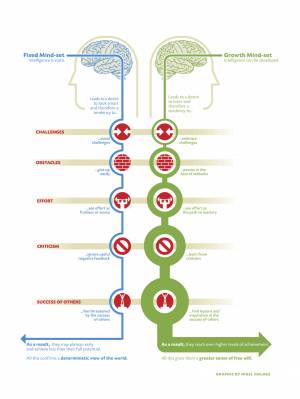
Carol Dweck: Differences between Growth and Fixed Mindsets

Carol Dweck has spent her career studying how personality traits impact life outcomes. Here is it summarized into one chart.

Dweck

You can see a larger image by clicking here: Full Size Image

More...

Fundamental Redesign of CIA Organizational Structure

The director of CIA has decided to that CIA needs a radical overhaul of its structure.  The NY Times reports:

Drawing from disparate sources — from the Pentagon to corporate America — Mr. Brennan’s plan would partly abandon the agency’s current structure that keeps spies and analysts separate as they target specific regions or countries. Instead, C.I.A. officers will be assigned to 10 new mission centers focused on terrorism, weapons proliferation, the Middle East and other areas with responsibility for espionage operations, intelligence analysis and covert actions.

During a briefing with reporters on Wednesday, Mr. Brennan gave few specifics about how a new structure would make the C.I.A. better at spying in an era of continued terrorism, cyberspying and tumult across the Middle East. But he said the current structure of having undercover spies and analysts cloistered separately — with little interaction and answering to different bosses — was anachronistic given the myriad global issues the agency faces.

During his two years as C.I.A. director, Mr. Brennan has become known for working long days but also for being loath to delegate decisions to lower levels of C.I.A. bureaucracy. During the briefing on Wednesday, he showed flashes of frustration that, under the C.I.A.’s current structure, there is not one single person in charge of — and to hold accountable for — a number of pressing issues.

Source: NY Times


Australia Post Swings to Losses in first time in 30 years

The Guardian reports on the problems of the existing business model:

Australia Post has warned its losses will amount to $6bn over the next 10 years unless the government allows it to change the price of sending letters.

The national carrier is forecasting its first full-year loss in 30 years, or since before it was corporatised.

Its chief executive, Ahmed Fahour, said Australia Post had a competitive parcel business, but losses from its letters business were swallowing up profits.

Fahour said the government understood the scale of the problem. “They either fund the next 10 years of losses, which could amount to $6bn, or we’re out of business,” he told Fairfax radio on Monday.

Australia Post reported a first-half profit after tax of $98m, down 56% on the first-half result of the previous year.

The letters business lost $151m, 57% worse than the loss in the first half of last financial year.

Fahour said Australia Post had never been subsidised and had always paid dividends to the government, but the world had changed.

“Either we get a massive injection from the government to keep the business going, or they give us the permission to manage the business and therefore no subsidy is required and the business can continue,” he said.

Letter volume decline accelerated to 8.2% year-on-year, the largest fall recorded since Australia Post’s letter volumes started falling in 2008.

A Good Strategy is like a Good Story

Tan Story

andresse

In this context this quote by Jim March also is relevant: 

“Leadership involves plumbing as well as poetry.”

Fairfax had trouble financing existing newspaper operations

The Guardian provides an update on how Fairfax, a company we features in our course 7 years ago, is doing:

Hywood counters by claiming that readership has never been higher – Fairfax’s website is the most popular news site in the country, and a barely-believable 5.1 million visitors access it every month. However, this is missing the point.

It is not readers, it is revenue that is needed to run those great full-service newsrooms. And cut-throat competition has driven online advertising through the floor – for every dollar a newspaper loses in print advertising it is lucky to recoup 10 cents online. Few newspapers are lucky enough to be owned by a trust, rather than accountable to shareholders, like the Guardian, or to attract a fairy-godfather like Amazon’s Jeff Bezos, who has adopted the Washington Post.

Hywood’s solution has been to diversify into a dozen different fields. Fairfax’s metropolitan newspapers now produce less than half its revenue. The company has morphed into selling baby goods, organising fun runs and ocean swims, a dating service, a real estate site. It has partnered with Channel Nine to launch a video-to-the-home service, though many fear this will end in tears. Apart from its unlikely name of Stan, it is about to face formidable competition from the world’s largest and most aggressive player in video-streaming, the US giant Netflix, which launches in Australia next month.

But many fear these ventures are just postponing the inevitable demise of the newspapers that have chronicled the country since the earliest days of white settlement, leaving Murdoch, at least for now, with a monopoly on everything Australians read in print. “They’ve saved the company, but f——d the papers,” as one analyst told me.

Useful if you consider submitting to AMJ: Editorial Statement by Current Editor of AMJ

I just read the editorial statement of the current editor of AMJ. If you would like to write about big problems that managers are facing in a scholarly way, AMJ may be a great outlet.

Gerry George writes:

A compelling way to frame a study for theoretical contribution is by asking questions on important anomalies or patterns that are intriguing, useful, and nonintuitive. In an earlier editorial with Jason Colquitt, I suggested that we need to explore “Grand Challenges” in management (see the June 2011 “From the Editors” [vol. 54: 432–435]). The principle is to pursue bold ideas and adopt less conventional approaches to address significant, unresolved problems. Not all our studies understandably will be grand, nor will they all challenge conventional wisdom, but considering the relative importance and scale of a problem will likely make a study more relevant to managers, and make it more interesting for our readers. There are multiple ways by which manuscripts can be better positioned for a theoretical and empirical contribution using a problem focus (Alvesson & Sandberg, 2011; Pillutla & Thau, 2013; also see the October 2011 “From the Editors” [vol. 54: 873–879]). What is important to recognize is that this team places emphasis on how a central research problem or question is articulated. Bringing organizational problems to the forefront would ease the burden on vaguely scripted “Managerial Implications” sections of manuscripts (Bartunek & Rynes, 2010).

My editorial team will look for clearly articulated problem statements or research questions motivated by managerial challenges. This problem-based focus shifts the emphasis away from motivating articles using pure theories to tackling important problems through an enriched theoretical lens. For example, Hekman and colleagues (Hekman, Aquino, Owens, Mitchell, Schilpzand, & Leavitt, 2010) motivate their study on gender and racial biases in customer satisfaction surveys by emphasizing the importance of the managerial problem that a 1 percent change in customer satisfaction creates a 5 percent change in return on investment. Understanding the scale and scope of the problem and asking the right question takes primacy over the deftness of theoretical manipulation using constructs, moderators, and moderated mediators. We prefer manuscripts that emphasize how constructs provide a coherent explanation of the phenomenon rather than framing and motivating studies by adding untested moderators and mediators. Such an effort would rightly dissuade authors from identifying smaller “gaps” in the literature and shift the discussion to managerial, organizational, and societal problems that need to be addressed.

Read the Full Editorial

Superb Example of Strategy Process Research:  New Paper by Laurent Mirabeau and Steve Maguire in SMJ

I just read a fantastic research paper that I recommend highly to anyone who is interested in strategy process research.

Mirabeau, L., & Maguire, S. 2014. From autonomous strategic behavior to emergent strategy. Strategic Management Journal, 35(8): 1202-1229.

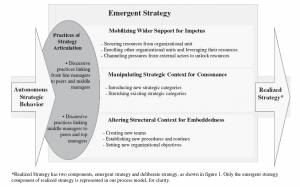
The authors do wonderful job first summarizing the different strands in strategy process research.  Then they present new findings on how autonomous strategic initiatives become emergent strategy. They introduce the new idea of Ephemeral Autonomous Behavior to balance out the traditional Mintzberg model of emergent strategies.  I have added the paper to my list of exemplary case studies worthy of imitation.

The core of the paper is nicely summarized in these two figures.

Mirabeau_McQuire_Fig6

(Right click on each figure to open it in a larger format on a new page.)

More...

Will give two presentations at Strategic Management Conference in Madrid, Sep 21-22

1. The Strategic Process and Competitive Dynamics of Industry Convergence

Date: Sunday, September 21, 2014
Time: 11:15 – 12:30
Room: Viena
Session Co-Chairs:

Samina Karim, Boston University
John Prescott, University of Pittsburgh

Panelists:

  * Alfonso Gambardella, Bocconi University
  * Anita McGahan, University of Toronto
  * Johann Peter Murmann, University of New South Wales
  * Fernando Suarez, Boston University

Understanding how industries change has attracted considerable attention because it blurs industry boundaries, redefines the competitive landscape, creates opportunities for new strategies to emerge, destroys competitive advantages while solidifying others, challenges cognitive maps and establishes new institutional arrangements. In this session, expert panelists will bring us up-to-date on the phenomenon of industry convergence (IC) by sharing their perspectives regarding (1) the antecedents, dynamics, and consequences of IC; (2) how to conceptualize strategic management processes and how they may inform the dynamics of IC; (3) how scholars should evaluate the attractiveness of, and rivalry within, IC industries; and (4) promising research directions including theory development and empirical studies.


More...

Who Matters More? The Impact of Functional Background and Top Executive Mobility on Firm Survival

Do some top executives matter more than others? Integrating insights from upper echelons and executive mobility research, we suggest that the functional roles performed by top executives shape their value to the firm. We examine the effects of inter-firm executive mobility on firm survival for New York City advertising firms from 1924 to 1996. We find that, while losing any top executive is damaging, the loss of a top executive whose functional role focuses on internal firm processes is more detrimental to firm survival than losing a top executive whose functional role focuses on managing external exchange relationships. Additionally, in situations when multiple executives leave simultaneously, firms are more negatively affected when the group departing is functionally heterogeneous.

Bermiss, Y. S., & Murmann, J. P. 2014. Who Matters More? The Impact Of Functional Background And Top Executive Mobility On Firm Survival. Strategic Management Journal:

Download article here.

An earlier version that placed more emphasis on heterogeneity of top management teams influencing firm survival is available at SSRN.

Read about article on the HBR Blog.

Laptops are a big distraction in the class room

I am inconsistent. I some contexts I have banned computers and more importantly smartphone use in classrooms because it became apparent that large number of students were distracted by it. It others I have allowed it because I myself like to take notes on a laptop. Here is the evidence why at least internet connections need to be turned off in classrooms.

Over time, a wealth of studies on students’ use of computers in the classroom has accumulated [...]. Among the most famous is a landmark Cornell University study from 2003 called “The Laptop and the Lecture,” wherein half of a class was allowed unfettered access to their computers during a lecture while the other half was asked to keep their laptops closed. The experiment showed that, regardless of the kind or duration of the computer use, the disconnected students performed better on a post-lecture quiz. The message of the study aligns pretty well with the evidence that multitasking degrades task performance across the board.
Pop quizzes, of course, are not the best measure of learning, which is an iterative and reflective process. Recent Princeton University and University of California studies took this into account while investigating the differences between note-taking on a laptop and note-taking by hand. While more words were recorded, with more precision, by laptop typists, more ended up being less: regardless of whether a quiz on the material immediately followed the lecture or took place after a week, the pen-and-paper students performed better. The act of typing effectively turns the note-taker into a transcription zombie, while the imperfect recordings of the pencil-pusher reflect and excite a process of integration, creating more textured and effective modes of recall.

Read full story in New Yorker

Previous Page   Next Page