About Johann Peter

Deepening the Conversation Between Business History and Evolutionary Economics

This article has appeared in the journal “Business History”, Volume 57, Issue 5, 2015.

Abstract: How can business historians and evolutionary economists deepen their conversations? The paper argues that in doing detailed studies of how individual firms develop capabilities over time is where the concerns of business historians who want to tell the history of individual firms and the concerns of evolutionary economists overlap. This is area where more extensive interactions would be most productive.

Download Article

This paper is a commentary on two articles:
1. Constructing an ‘industry’: the case of industrial gases, 1886–2006 by Ray Stokes & Ralf Banken
2. The evolution of the pharmaceutical industry by Franco Malerba & Luigi Orsenigo

Tips for Choosing Appropriate Level of Abstractions (especially for Chinese Researchers)

A lot of Chinese researchers simply want to imitate how top American journals in formulating theories without boundary conditions. This sounds like doing good science but more often its leads to superficial analyses that do not explain what is happening in China. I was asked to write a commentary on an article by Child and Marinova (2014) in Management and Organization Review and this gave me a chance to reflect more broadly on choosing the appropriate level of abstraction in social science Research.  The article is now published.

Reflections on Choosing the Appropriate Level of Abstraction in Social Science Research. 关于在社会科学研究中选择适当的抽象水平的反思

Abstract: Although researchers often do it subconsciously, every explanation involves choosing a level of abstraction at which the argument proceeds. The dominant North American style of research in Organization Theory, Strategy, and International Business encourages researchers to frame their explanations at the highest level of abstraction where country-level contextual factors are suppressed or ignored. Yet to provide powerful explanations for recent developments in China, researchers are drawn to a greater level of context specificity. This tension is evident in the Child and Marinova (2014) paper. One way to reduce the tension is to identify general causal mechanisms that combine in different ways to produce different results depending on context. This research strategy is more effective than seeking invariant, general patterns of development across all times and places.

Keywords: choosing level of abstraction;philosophy of social science;research design;research on industries;research on firms 选择抽象的水平;社会科学的哲学;研究设计;行业研究;企业研究

MOR Abstract

Download Article.


The role of home country demand in the internationalization of new ventures

My article with Salih Ozdemir and Deepak Sardana was just published in Research Policy.

Abstract: International new ventures (INVs) have been documented to exist all around the world, but the literature is silent on the frequency of such companies in different countries. We contend that the propensity of new ventures to internationalize by forming international partnerships is higher in small-domestic demand countries because they have a greater motivation given their limited local demand. After discussing the methodological challenges in testing this hypothesis, we do such a test by studying alliances in the health segment of the biotech industry in relatively small-domestic demand countries (Australia, Israel, and Taiwan) and by comparing the results with five large-domestic demand countries (UK, Germany, France, US, and Japan). We find that young firms in the countries with smaller domestic demand are at least 3 times more likely to enter into international partnerships than their counterparts in countries with larger domestic demand. We further demonstrate that this difference can primarily be explained by the difference in the size of domestic healthcare markets rather than other underlying opportunity structure related factors.

Keywords: International new ventures; Internationalization; Small vs. large demand countries; Young biotechnology firms; International partnerships; Business development partnerships

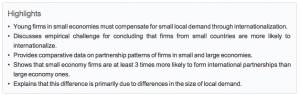
Highlights of article

Read and Download Full Article here

Tesco Business Model in Trouble

The economist reports on the trouble of Tesco as UK consumers shopping habits change and the German discounters Aldi and Lidl roll our their operational models in the UK.

By any measure the figures were eye-popping, worse even than most analysts had expected of the struggling company. Tesco made the largest pre-tax loss, of £6.4 billion ($9.6 billion), in British retail history, eight times as much as the previous record, set by Morrisons last year. This was also the sixth-largest loss in the country’s corporate history. Most of it (about £4.7 billion) was due to a fall in the property value of Tesco’s British stores. This was not merely an accounting matter, but a sign of how its out-of-town hypermarkets have fallen out of favour with consumers who shop online or use smaller convenience stores. Underlying profits were 68% down on the previous year, at £961m, and overall sales were down by 1.8%. The stock that Tesco keeps in its warehouses is worth £570m less than previously thought, and the pension scheme is £3.89 billion in deficit. And so on.

Full Story on Economist.com

Gerhard Steidl’s Fundamental Objective for his Printing Business

Gerhardt Steidl was asked: Many people call you the “king of printing” and some artists will trust no one else with their books. In what way are Steidl’s books different than other books?

He replied:

Most of the publishing houses in the world are owned by shareholder companies and their interest is to make profit. My publishing house is a private business. I founded it in 1968 and it is still owned by me. It is a family business. It is a Manufaktur and we don’t set any limits on cost. A Steidl book is always made in Germany, in Göttingen, in Düstere Straße 4 and there is a guy, Gerhard Steidl, who is hands on. So, believe it or not, I oversee every sheet that tumbles out of our press. This craftsmanship and this know-how we bring to every one of our babies, our books, makes a huge difference compared to the production processes of other companies.

Source:  The Talks

Short Case Study of Oracle’s Transformation

The Arc of Company Life - and How to Prolong it provides a good story case illustration using the transformation of Oracle


oracle

What is impact investing

CEO of Qantas highlights that some private investors explicitly do not focus on financial returns but on social impact. This is called impact investing. 

Joyce writes on LinkedIn: It’s not a well-known term in Australia, perhaps because our economic prosperity makes it seem less relevant. But the impact investment market here is growing, targeting areas of social disadvantage that government funding alone can’t fix, from unemployment to homelessness. The point of difference is that an investment relationship requires much more sustained engagement between the investor and the business they’re supporting, compared with a one-off donation or grant.

Indigenous businesses have a particular interest in the potential for impact investment. The Forrest report found that Indigenous enterprises are 100 times more likely to employ Indigenous Australians than other businesses, so building the capacity of these enterprises is vital. Organisations like the CAPE Fund in Canada and Indigenous Business Australia show the way forward, and Qantas is playing a role through our Reconciliation Action Plan, partnerships with Career Trackers and Supply Nation, and backing for ventures such as the North Kimberley carbon offset project.

To read more about impact investing on the Inside Policy blog, click here, and to read John Simon’s landmark report, More than Money, click here.

Murmann Lecture: What constitutes a compelling case study?

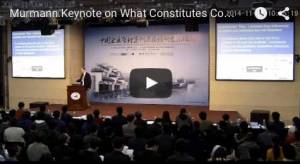
I gave a 50-min keynote lecture on what constitutes compelling case study.  The video from the event at the Forum for Case-based and Qualitative Research in Business Administration may be useful for anyone who is attempting to publish case based studies in field of management.

Nanjing Lecture

The slides from the lecture are visible in the video and can also be downloaded here.  Murmann Slides

The lecture is also available within China on the youku platform.  Click here if you want to access video from China:  China Video AccessAlternative China Video Access

Click on “more” for a written summary of lecture both in English and in Chinese.

More...

Getting a better sense of just how small a nanometer is

I am doing a bit of research on history and prospects of nano technology. Since 2000 the US government has an a nano technology initiative to ensure that the country stays what people consider a radical new technology to create new materials and structures. The chips in our computers and smartphones are getting ever more powerful because engineers are able to use nano technology to pack ever more transistors onto a chip.  In addition to providing useful short history of nanotechnology, Nano.gov gives an useful illustration just how small is “nano”?

Nano Scale

More...

Bookshops are closing, here is new business model for a pop-up bookshop

I have seen a lot of bookshops go out of business, including the famous bookshop on Telegraph Avenue in Berkeley. From Adelaide comes a new business model for having a physical bookshop that moves to different locations in the city.  A pop-up bookshop. The owners write:

Curating an ever-evolving, eclectic mix of old, new and collectible books (in itself somewhat out of step), we’ve popped up in various locations, in various styles, within Adelaide’s CBD. On the street, at boutique markets, in cafes, empty shopfronts, arcades. The idea being that by putting ourselves in plain view, we remind people that bookshops exist.

Well, that’s our story too. In November 2013, we pushed ourselves by leasing a space on Adelaide’s main retail strip, Rundle Mall. Next door to French Connection, across from Nespresso, sharing mall frontage with Apple and Nike. It was a make-or-break philosophy – and we received the most amazing reactions from the public who just couldn’t believe what they’d stumbled upon. It lasted four months and we were encouraged enough by that success to give Rundle Mall another go this year. We’re putting a bookshop on the main stage in a city where people constantly – interminably to us – decry the fact there are “no bookshops in Adelaide”.

But how can this work? Our bookshop is a business. Businesses survive by making money. Bookshops don’t make enough money to pay big rents. All these statements are true, more or less. All we have is a complete, unfaltering faith that what we’re doing is worthwhile and important and, because of this, we’ll be OK.

At the moment, we sell just enough books to pay our wealthy landlord, buy stock and cover our modest living expenses. It’s long hours, risky and stressful but we love it. We need to make money to survive but aren’t driven by money. In fact, the short answer to the “how can it work?” question is that we sacrifice money for lifestyle. We treat it as a seasonal occupation, working unsustainably hard for a short period of time then taking a break.


Full Story in the Guardian

Previous Page   Next Page