About Johann Peter

African CEO of Credit Suisse faces revolt

As far as I can tell, Thian is trying to move Credit Suisse in the right direction to make the firm more sustainable. But a large fraction of employees is in open revolt again him. Will be successful. The NYT reports: “When Tidjane Thiam took over at Credit Suisse last July, he laid out a new direction for a financial giant with a storied investment banking history: Do less investment banking. [...] One year in, Credit Suisse stock is down 50 percent. And the investment bank, the second largest in Switzerland after UBS, is in open revolt.” Read full story.

The 10 Most Valuable Brands in Australia

Australia’s most valuable brands. I would have not guessed them correctly.

Using Simulation Experiments to Test Historical Explanations

I wanted to test with a computer simulation the explanations I offered in my book Knowledge and Competitive Advantage: The Coevolution of Firms, Technology and National Institutions for why German firms overtook their French and British competitors in the Synthetic Dye Industry from 1857-1913. So I partnered with Thomas Brenner who has created a simulation model that can replicate the key stylistic facts we know about firm and industry growth patterns. Our paper is now published online the Journal of Evolutionary Economics.
Conducting Simulation Experiments to Test Historical Explanations: The Development of the German Dye Industry 1857-1913

Abstract: In a simulation experiment, building on the abductive simulation approach of Brenner and Werker (2007), we test historical explanations for why German firms came to surpass British and France firms and to dominate the global synthetic dye industry for three decades before World War 1 while the U.S. never achieved large market share despite large home demand. Murmann and Homburg (2001) and Murmann (2003) argued that German firms came to dominate the global industry because of (1) the high initial number of chemists in Germany at the start of the industry in 1857, (2) the high responsiveness of the German university system and (3) the late (1877) introduction of a patent regime in Germany as well as the more narrow construction of this regime compared to Britain, France and the U.S. We test the validity of these three potential explanations with the help of simulation experiments.  The experiments show that the 2nd explanation—the high responsiveness of the German university system— is the most compelling one because unlike the other two it is true for virtually all plausible historical settings.

Download Paper

Beyond Profits: Tesla’s fundamental objective to hasten the transition to electric vehicles

Elon Musk gave an interview that makes it clear that the fundamental objective for Tesla is not profits.


Question: The German automakers just presented their responses to Tesla in Frankfurt at the international automobile show. What do you think of the Audi e-tron quattro and the Porsche Mission E?

Any action in the direction of electric mobility is good. Our goal at Tesla is for cars to transition to e-vehicles. That’s why we opened up all our patents for use by anybody.

And who has used them?

Maybe the companies you already mentioned. When I saw a diagram of Porsche’s Mission E, I thought: It looks exactly like our car. Which is fine. It’s more important to accelerate the advent of sustainable transport.

tesla

Source: Handelsblatt.com

“The Moon and the Ghetto” revisited by Richard Nelson

Richard Nelson explained why is worthwhile to revisit his book.

Over thirty years ago I wrote an extended essay, The Moon and the Ghetto, concerned with the troubling question of why societies so rich and capable technologically and organizationally as to be able to land a man on the moon seemed unable to deal effectively with e.g. poverty, illiteracy, slums. I argued that, while politics was part of the reason, in many cases the problem was that our scientific knowledge and technological know-how was not sufficient to point the way to a solution. The general problem of the great unevenness of human progress has not gone away. The questions explored in this seminar are, first, what lies behind the great unevenness of scientific and technological progress. And second, under what conditions does it make sense to seek a solution to a problem by trying to develop stronger know-how. Can progress be made by reorienting our innovation systems?

You can watch his lecture given at INGENIO in Spain on Youtube.

Nelson Ghetto

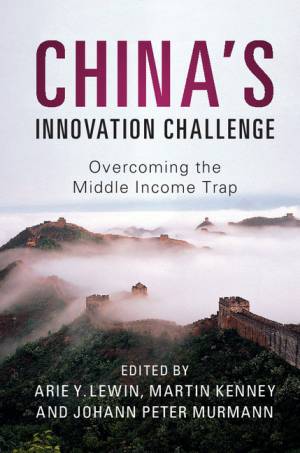
“China’s Innovation Challenge” published with Cambridge University Press

Arie Lewin, Martin Kenney and Johann Peter Murmann edited a new book on China’s Innovation Challenge: Overcoming the Middle-Income Trap.

New March 2016: Download Fronter Matter and Introductory Chapter

The book will also feature contributions from Justin Yifu Lin, Gordon Redding, Michael Witt, Keun Lee, Douglas Fuller, John Child, Simon Collison, Yves Doz, Keeley Wilson, Silvia Massini, Keren Caspin-Wagner, Eliza Chilimoniuk-Przezdziecka,  Weidong Xia, Mary Ann Von Glinow, Yingxia Li,  Zhi-Xue Zhang and Weiguo Zhong, Chi-Yue Chiu, Shyhnan Liou, and Letty Y-Y. Kwan, and Rosalie Tung.

Detailed Table of Contents

Join discussion and get updates on the book by following its Facebook Page.

China Innovation

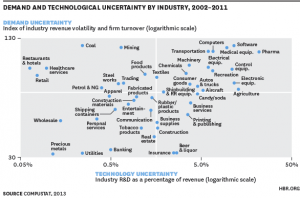
How much uncertainty is there in different industries

Jeff Dyer, Nathan Furr, and Curtis Lefrandt have put together a useful graphic on the relative uncertainty in different industries.

uncertainty

Full Story on HBR.org

Game Theory:  Why it became so popular and why it often is hard

John Cassidy explains in the New Yorker:


Thanks to the sterling efforts of Sylvia Nasar, Ron Howard, and Russell Crowe, many people are aware that John Nash, the Princeton mathematician who was killed over the weekend in a car crash on the New Jersey Turnpike, lived a remarkable life. It included early academic stardom, decades of struggling with schizophrenia, and, in 1994, a shared Nobel Memorial Prize in Economic Sciences. But outside the field of economics, Nash’s contribution to game theory, for which he was awarded the Nobel, remains rather less well understood.

Although it is often used in economics, game theory can be applied to any venue where people, or other decision makers, interact strategically and follow rules-based behavior. The setting could be nuclear negotiations, such as the ones currently taking place between Iran and the great powers. It could be a product market, in which a number of firms compete for business. Or it could be a political campaign, in which various candidates try to outdo each other. The word “strategically” is important, because the various players, in choosing from a variety of possible moves, take account of one another’s actions, or likely actions. And the phrase “rules-based” means that the players are acting purposefully and seeking to maximize their own advantages, rather than behaving passively, or randomly.


Full Story

nas

More...

Kickstarter reincorporates itself as “public benefit company”

The founders of Kickstarter wanted to ensure that their company does not stray from their fundamental objective of ““help bring creative projects to life.” Now they have reincorporated themselves as “public benefit company”.  The NY Times reports:

As co-founders of Kickstarter, the popular online crowdfunding website that lets people raise money to help fund all manner of projects, including cooking gadgets and movies, Mr. Strickler and Mr. Chen could have tried to take their company public or sell it, earning millions of dollars for themselves and other shareholders.

Instead, they announced on Sunday that Kickstarter was reincorporating as a “public benefit corporation,” a legal change they said would ensure that money — or the promise of it — would not corrupt their company’s mission of enabling creative projects to be funded.

“We don’t ever want to sell or go public,” said Mr. Strickler, Kickstarter’s chief executive. “That would push the company to make choices that we don’t think are in the best interest of the company.

Read Full Story

kickstarter eating area

Review of “China’s Path to Innovation” by Xiaolan Fu

To date there are few research monographs that go beyond picking out striking cases of innovative companies. We clearly also need systematic analyses of China’s growing innovative capacity. For this reason, Xiaolan Fu’s book China’s Path to Innovation (Cambridge University Press, 2015) is a welcome addition to the literature. Fu is Professor of Technology and International Development at Oxford and has written about innovation in China for more than ten years. China’s Path to Innovation has 16 chapters (Table of Contents).  The book provides an excellent overview of scholarly literature on the development of Chinese innovative capacities. It deserves to be in the library of anyone working on China’s innovative capacity.  Read my full review on economic-evolution.net.

Previous Page   Next Page