About Johann Peter

WEBA (Weaving Company Appenzell), Switzerland

This is an information video how WEBA (Weaving Company Appenzell), Switzerland, is able to produce high cloth for shirt fashion designers.

Former Southwest Airlines CEO’s Personal Fundamental Objective

“Anybody who seeks wealth as an end in itself is always going to be disappointed,” he said in 1995. “What you really should be doing is seeking excellence in achievement.”


Source: Washington Post Obituary

History of St. Gallen’s Contribution to the Textile Industry

st gallen


Historical Slide Show

Eastern Switzerland Region from which to draw firms for histories.


What Does the Success of Tesla Mean for the Future Dynamics in the Global Automobile Sector?

After reading Jacobides, MacDuffie, and Tae (2016), the success of Tesla in launching a new automobile company in a crowded sector puzzled us. Jacobides, MacDuffie, and Tae (2016) had convinced us that developing the capabilities to become the manufacturer of a complete, safe automobile system would be quite difficult. Researching the development history of Tesla, we have pieced together the key features of how Tesla achieved its successful entry into the automobile sector. From this we have concluded, based on the development time and costs associated with the Tesla Model S, that a well-funded company could develop a new electric vehicle (EV) from scratch and move it into production within 3 to 5 years, by spending $1–2 billion of capital for design, development, and manufacturing. Without a doubt, increasing production to the levels of mass producers would take much longer, but the Telsa example demonstrates that new entry into the industy has become feasible. Tesla’s trajectory, from start-up on the brink of bankruptcy to a company mass producing electric vehicles within 5 years, raises important questions about the future of the global automobile sector. What would prevent Apple and Google, two companies that clearly have the resources to fund $2B in R&D, from entering the market and contesting fiercely with the dominant OEMs such as GM, Ford, VW, Mercedes, and Toyota? There are already many ventures in the Chinese electric automobile sector, such as BYD, Qiantu, NIO, and many more. Inspired by the success of Tesla, why would Chinese software and internet giants such as Tencent and Alibaba not enter this large market given that Tesla did not have prior experience and was able to get a successful car ready for sale within 5 years? In this perspective piece, we offer our reflections on the implications of the success of Tesla for the dynamics of the global automobile sector. We will appraise the chances that Chinese firms will for the first time become leading players in pushing the frontier of automotive technology, a goal that has eluded them over the past 30 years despite massive government efforts to create strong home-grown auto companies.

Download Article: G. Perkins and J.P. Murmann, “What Does the Success of Tesla Mean for the Future Dynamics in the Global Automobile Sector?” Management and Organization Review, 2018

There are three commentaries on our articles that make for a very spirited debate.


J.P. MacDuffie, “Response to Perkins and Murmann: Pay Attention to What Is and Isn’t Unique about Tesla” Management and Organization Review, 2018.

H. Jiang, F. Lu, “To Be Friends, Not Competitors: A Story Different from Tesla Driving the Chinese Automobile Industry” Management and Organization Review, 2018.

D. Teece “Tesla and the Reshaping of the Auto Industry” Management and Organization Review, 2018.


Finally, Liisa Välikangas provides an introduction to the “Forum on Tesla and the Global Automotive Industry”  Management and Organization Review, 2018.


Tesla

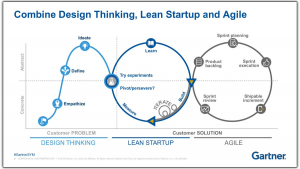
Relationship of Design Thinking, Lean Startup and Agile Methodologies

DT

Source:Medium

Interview with Professor Denise Rousseau

If you have been taught that relationship conflict (A-conflict) in teams is bad for team performance but arguing about tasks (C-conflict) is good, I encourage you to read my wide-ranging interview in BusinessThink with Professor Denise Rousseau (Carnegie Mellon University), the originator of this idea. After seeing the systematic evidence, she changed her mind and now is a leader in the movement to make management practice more evidence-based. I learned a lot from her while she was distinguished visiting scholar at UNSW earlier this year. To help spread her important message about evidence-based management, I interviewed Denise for BusinessThink. Watch a video of this interview or read the edited transcript that appeared originally in BusinessThink. If you like it, please share it!

More Exploration and Less Exploitation: Cultivating Blockbuster Papers for MOR
MOR_CoverLet me invite you to travel in your mind to the year 2030. Imagine that you are one of the Senior Editors of MOR and have been asked by the Editor-in-Chief to write a short retrospective on the previous 15 years. Delighted to take on this task, you compose an editorial along these lines:

Dear MOR readers and contributors:
Thomson Reuters has just released its journal impact factor ranking for 2029. For the past five years, we have ranked in the top 15 out of 220 management journals, and last year, for the first time, we ranked fifth. This is a large improvement from 15 years ago, when we ranked at no. 33 out of 192 management journals. Even more positively, a recent poll by the Academy of Management, whose non-US membership has now exceeded 80% from a little over 50% in 2015, revealed that MOR has been found to be one of the top five journals that Academy of Management (AOM) members consistently read. In the qualitative section of the AOM survey, respondents offered comments such as:
‘If you want to get a deep understanding of key management problems that transforming economies face, then MOR is by far your best source’.
‘I was never much interested in Africa, but after reading the article in MOR that documented a genuinely new organizational form in Kenya, I was inspired to partner with a scholar at University of Nairobi to develop potentially new theoretical insights by comparing alliance governance practices in Kenya and in Brazil’.
‘Many of the top management scholars first try to get their work published in MOR. The journal has developed a reputation for publishing the freshest ideas. I think this is in large part because in MOR management scholars have more consistently partnered with scholars from non-obvious fields, such as urban planning, public policy, public administration, cultural anthropology, environmental engineering, and development studies, which proved particularly useful to understand Chinese management challenges’.
‘I follow MOR closely since there is always a good chance that I will come across an article that later turns out to be real blockbuster. This allows me to build on these creative articles before everyone else does’.

These statements are compelling evidence that MOR has developed a strong reputation beyond the narrow Thomson Reuters impact factor score, which fluctuates more from year to year at MOR than at other journals because of MOR’s long-standing strategy of cultivating blockbuster papers, rather than a continual series of incremental papers.
It would be foolish for us to think that MOR’s success is simply due to having recruited more brilliant editors than those at other journals. Clearly, elements of luck are involved in why MOR has become so influential that have little to do with the skills of past editorial teams. MOR benefited greatly from the general trend in which the countries regarded as transforming economies in 2015 (e.g., China, Indonesia, India, Pakistan, Bangladesh, the Philippines, Brazil, Nigeria, Ethiopia, Egypt) increased their share of the world economy much more rapidly than was predicted that year.
But we can also credit explicit strategies for MOR’s success: first, Arie Lewin’s (2014) push to broaden MOR from a China-focused journal to one focused on all transforming economies; second, a systematic push to motivate authors to write and submit papers that had the potential to push scholarship in a new direction; third, the development of an ethos that motivated editors and reviewers to go the extra mile to nurture creative papers even before they were submitted to the journal.
Looking to the future, our greatest challenge will be maintaining these strategies and not losing our cool when the impact factor drops for a year or two before another set of blockbuster papers raises it again. Today, let us celebrate what MOR has achieved over the past 15 years. Thanks are due to all the authors and editors who made this possible.
Now let us return to the here and now and discuss more explicitly some of the strategies that we have already put in place to increase the chances that MOR will become the home of blockbuster papers. Building on the themes of this imaginary 2030 editorial, I now want to articulate additional strategies that we should implement to attract more blockbuster papers.

Continue Reading on the MOR website at Cambridge University Press.

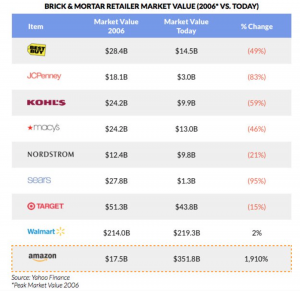
Brick and Mortar Retailers 2006 and Now

Amazon gained a lot more value then the big brick and mortar retailers list.  But would this still be the case if the value destruction at all the small retailers that Amazon put out of business were accounted for? Think of Cody’s bookstore in Berkeley.  Brick and Mortar

“All the news that fit on smartphone”: NYT continues to face transformation challenge

The NYT Times has worked hard to cut costs and get people to pay for digital content. It has been more successful in this quest that many other newspapers around the world.  But as more and more people read their news on smartphones, it faces challenges from digital-only news sources. Politico has published an insightful piece on the big transformation that still lies ahead for the NYT if it wants defend its position as leading news organization.

Politico.com: New York Times braces for big change

Previous Page   Next Page