About Johann Peter

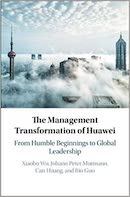
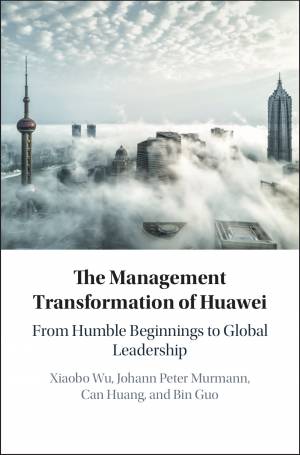
The Management Transformation of Huawei: From Humble Beginnings to Global Leadership

Huawei has become China’s most prominent multinational company and a leader in the ICT sector. Given unprecedented access to the company, the authors of this book examine the management transformation of Huawei from its inception in 1987 until 2019, observing in detail not only the creation of its organizational routines but also the breaking of routines across most major functional areas: Management, Product Development, HR, Supply Chain, Finance, R&D, Intellectual Property, and International Business. ‘Dynamic capabilities’ are central to theories of competitive advantage and this book highlights Huawei as an ideal case study for the successful implementation of change routines and change-supporting values. The chapters cover all the major change initiatives the firm has undertaken since 1996 to import best practices from the West, with the help of consultants. The insights presented in the book will be particularly interesting for academics in the field of strategy, management, and business history.

Table of Contents and ordering

Download the Overview Chapter

Huawei


Endorsements

‘This is a ‘must read’ book for whoever is interested in the rise of China. It provides unique empirical and conceptual insights on China’s leading company and draws on world class researchers for analysis and commentaries. Uniquely valuable!’
Yves Doz, Solvay Chaired Professor of Technological Innovation, INSEAD

‘The Management Transformation of Huawei provides a fascinating account of how Huawei preserved its entrepreneurial spirit as it rapidly scaled up over its 30-year history. Very few studies provide such an in-depth historical account of the evolution of a company over such a long period of time. Any scholar or practitioner interested in understanding the leadership challenges that arise with rapid organizational growth should read this book.’
Ranjay Gulati, Paul R. Lawrence MBA Class of 1942 Professor of Business Administration, Harvard Business School

‘Huawei has become a major player in the global electronics industry and has been - perhaps unwantedly - cast into the role of a significant geopolitical force. This book is important and interesting because of the astonishing story of Huawei’s corporate growth. The authors provide an insightful account of how Huawei transformed itself from a small startup into a global giant, making an important scholarly contribution under major headings of the strategic management literature, such as ‘knowledge’, ‘routines’ and ‘dynamic capabilities’.’
Sidney G. Winter, Deloitte and Touche Professor Emeritus of Management, Wharton School, University of Pennsylvania


Cambridge University Press Book page


Striking Similarities to Spanish Flue outbreak in 1918

We have heard about the similarities of COVID-19 to the Spanish flue, but here is it told well in a short video.

Why gave hydrogen-powered car not become mainstream even though they were hyped in already in 1974

GM had a hydrogen-powered bus in 1967. VW and Mercedes had experimental hydrogen-powered cars in mid-1970s. Here is a list of vehicles produced by various companies. WSJ.com has produced a great video explaining why hydrogen cars are still not around the corner, despite the technology’s great promise.

VW CEO uses history to explain why VW needs to speed up change to avoid the fate of Nokia

This is a Deepl AI translation of the speech of VW CEO to employees in January 2029. The complete speech of the VW boss in the wording:

“Ladies and gentlemen,

the world is on the move. Politically and technologically, we live in an incredibly dynamic time. A turn of an era stands before us - from the dimension of the industrial revolution. And Volkswagen is in the midst of the storm of the two greatest transformation processes:

- Climate change and the associated pressure to innovate towards emission-free driving.

- And digitalisation, which is fundamentally changing the automobile as a product.

Our Group is not always in the best position to react quickly and systematically enough to these developments. Measured against this, we have not done badly so far. This is also acknowledged by market observers. In 2019 in particular, analysts have gained new confidence in our strategy.

At the beginning of this year, Kepler Cheuvreux attested: “We think VW is the best positioned player in the industry to master the CO2 challenge. And Goldman Sachs says: “We expect VW Group to continue to prosper this year as a result of ongoing positive sales developments at VW brand, a pick-up in sales at Audi, and broadly flat margins.

In the Litigation area, we are making the risks from the diesel crisis more manageable step by step. In terms of corporate culture, we are seeing tangible and measurable progress. I am pleased that we have increased our integrity by three points in the sentiment barometer.

Our modern MQB-based model range in terms of volume and the new Porsches, Audis, Lamborghinis and Bentleys are convincing customers. We are improving the quality of our business. Revenue and earnings are growing faster than unit sales. In China, we increased our market share by 1.4 percent in a sharply declining market. This is a great achievement, which hardly anyone would have expected from us. Congratulations to Stephan Wöllenstein and his team on their outstanding performance!

In South America we are back in the black for the first time, and we have also turned our business around in Russia. In North America, we have significantly improved our earnings and are aiming to break even this year. Volkswagen Financial Services will have a record year in 2019, and the component has taken decisive steps in battery development and production.

At Audi, the e-tron got off to a successful start, development costs were reduced and a comprehensive cost reduction programme was launched. Porsche has once again delivered excellent figures and cars and set an example with the Taycan. Seat conquers new and young customers with Cupra. Skoda is running at full speed and will present the new models in India, an important future market for us, at the beginning of February.

VW Commercial Vehicles has put the extremely important Ford cooperation on track, and Traton has completed its IPO. We are seeing positive trends at Bentley, Ducati, Bugatti and Lamborghini, and Bentley in particular is back in the black. The Volkswagen core brand has worked hard to further increase returns. All in all: good developments.

“The storm is just beginning”

More...

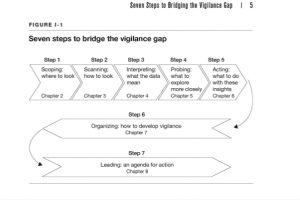
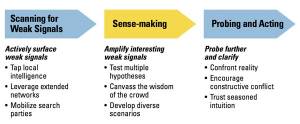
Framework and Toolkit for Improving Peripheral Strategic Vision

Day and Shoemaker have developed a useful framework and toolkit for assessing how much peripheral strategic vision your company needs.

An MIT Sloan article lays out the ideas in three steps.

More details on the toolkit are in their HBR article that can be assessed here.

The Innovation and Entrepreneurship Ecosystem in India

India began the process of market liberalization that opened it to significant interactions with the world economy in 1991. In this essay, we provide an overarching view of the country’s journey toward integration with the global innovation and entrepreneurship network. Major nodes in this global network have two major components that may be metaphorically referred to as ‘pillars and ivy’. Globally connected multinational enterprises (MNEs) form the pillars. Agile startups are the ivy, and their success (metaphorically, the height to which they can climb) depends on their symbiotic connections with the pillar MNEs. Both components are essential and reinforce each other. Without MNEs, the scaling of startups is hampered. Without a vibrant population of startups, MNEs’ interest in a location remains driven by cost, rather than capability and creativity. MNEs (mainly foreign) provided the initial sparks for the formation of the Indian innovation and entrepreneurship ecosystem. We chart the subsequent growth of India’s startups. They began in the information technology (IT) sector but now cover a much wider range of industries. Today, India’s innovation and entrepreneurship ecosystem is one of the largest in the world, with global integration in terms of technology, financing, human capital, and administration.

This is the introductory essay to a Special Issue of Management and Organization Review on The Innovation and Entrepreneurship Ecosystem in India.

taj

On Strategic management, leadership & the success of Huawei

I did a four-minute interview with the HSG Focus Magazine.

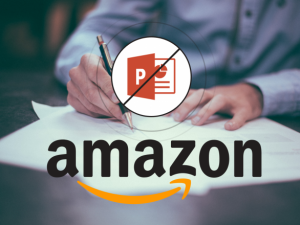
“We do not do PowerPoint at Amazon”

Jeff Bezos explains in an annual letter to shareholders that Amazon bans PowerPoint presentations.


Six-Page Narratives

We don’t do PowerPoint (or any other slide-oriented) presentations at Amazon. Instead, we write narratively structured six-page memos. We silently read one at the beginning of each meeting in a kind of “study hall.” Not surprisingly, the quality of these memos varies widely. Some have the clarity of angels singing. They are brilliant and thoughtful and set up the meeting for high-quality discussion. Sometimes they come in at the other end of the spectrum.

In the handstand example, it’s pretty straightforward to recognize high standards. It wouldn’t be difficult to lay out in detail the requirements of a well-executed handstand, and then you’re either doing it or you’re not. The writing example is very different. The difference between a great memo and an average one is much squishier. It would be extremely hard to write down the detailed requirements that make up a great memo. Nevertheless, I find that much of the time, readers react to great memos very similarly. They know it when they see it. The standard is there, and it is real, even if it’s not easily describable.
Here’s what we’ve figured out. Often, when a memo isn’t great, it’s not the writer’s inability to recognize the high standard, but instead a wrong expectation on scope: they mistakenly believe a high-standards, six-page memo can be written in one or two days or even a few hours, when really it might take a week or more! They’re trying to perfect a handstand in just two weeks, and we’re not coaching them right. The great memos are written and re-written, shared with colleagues who are asked to improve the work, set aside for a couple of days, and then edited again with a fresh mind. They simply can’t be done in a day or two. The key point here is that you can improve results through the simple act of teaching scope – that a great memo probably should take a week or more.

Source: Annual Report 2018


pp

US Big Business Lobby Group Updates Mission of the Public Corporation

Fortune Text accompanying this: The Business Roundtable Issues Updated Statement on the Purpose of a Corporation.

The Economist takes a more critical stance.

Curious First in the World: KLM airline wants its customers to fly less.

KLM wants its customers to fly less. What does this mean for what are KLM’s fundamental goals?

Previous Page   Next Page