

I have created a number blogs to publish useful information. One is a Teaching Blog dedicated to providing past, present and future students useful information.
My Research Blog is dedicated to disseminating useful information to other researchers and scholars.
A new blog is focused on how to improve forecasts, which is a key strategic skill: forecasting-strategy.ch
To track progress in machine learning, I also run an AI blog.
There is also a blog that has collected all of Charles Tilly’s Writings on Methodology.
Below you find every entry across all my Blogs.
Posted by Johann Peter Murmann


The content management system powering this website is over 20-years old. The https version of it is not working properly. Take out “s” in the from https and with http: the website is still working. Bear with us us we are migration the website to a modern CMS.
Peter Murmann January 2026
Categories:
Posted on Jan 28, 26

Research Focus on Auto Industry
My research team is interested in studying how to improve strategic forecasting ability. As a key empirical context, we have selected the auto industry undergoing dramatic technological changes.

Click on the picture to access auto-future.org
Categories: Innovation | Management |
Posted on Apr 11, 24

My presentation at Darwin Club: Evolutionary Theory in Strategic Management

Click on picture to play video
Categories: Lectures |
Posted on May 07, 23

New Competition in the auto industry: Incumbents versus startups
I have two new publications about the new competition in the auto industry.
A Capabilities Framework for Dynamic Competition: Assessing the Relative Chances of Incumbents, Start-Ups, and Diversifying Entrants (with Fabian Vogt in Management and Organization Review)
Exploring the structure of internal combustion engine and battery electric vehicles: implications for the architecture of the automotive industry (with Benedikt Schuler in Industrial and Corporate Change)
Categories: Innovation | Management | Writing |
Posted on Feb 15, 23

Forum on ‘The Rise of China’s Digital Economy’
In this forum, we present three essays that collectively seek to document and explain the rise of China’s digital economy. The first essay written by Hong Jiang – who is based in China – and myself – who is based in the West – focuses on documenting the rise of China’s digital economy by comparing it systematically with developments in the United States (Jiang & Murmann, 2022). This first essay intentionally says relatively little about the causes driving the rise so that the two invited teams of commentators could focus on reasons behind the growth of e-commerce and internet services in China. The first team, composed of Chong Ma, Ji-Ye Mao, and Xiao-Peng An (2022), is based in China and the second team, composed of Martin Kenney and Arie Y. Lewin (2022), is based in the United States. Both teams were provided with the opening essay and a set of questions to stimulate a debate about causes.
• Is the increasing strength of these digital sectors intimately tied to government policies? If so, how?
• Is the fact that China is much more lax about privacy a critical reason for the advances in China?
• Will China overtake the US in these digital services or will the fast growth slowdown?
• On the assumption that the geopolitical struggles between China and the US continue to rise, what, if any implications will this have for the further development of e-commerce and digital services companies in China and the US?
• The Chinese government recently has made it more difficult for Chinese firms to list on US stock exchanges; will this have a negative impact?
Categories: China | Innovation | Economics |
Posted on Oct 02, 22

Adam Grant on the Four Deadly Sins of Culture
He says:
People often claim their cultures are unique. But when you study thousands of organizations, you can start to see underlying patterns.
It all has to do with how we balance key priorities. Research reveals that there are two fundamental tensions in organizational culture: Results vs. relationships and rules vs. risk. If you ignore one of these values altogether, you end up committing one of my 4 deadly sins of organizational culture: toxicity, mediocracy, bureaucracy, and anarchy.
The first sin of culture is Toxicity. It’s the deadliest sin of them all. New evidence on the Great Resignation shows that toxic culture is the biggest driver of turnover–more than burnout, more than low pay. Toxicity exists when a culture prioritizes results without relationships. Getting things done at the cost of treating people right. The organization tolerates disrespect, abuse, exclusion, unethical decisions, and selfish cutthroat actions. If people don’t get fired for those behaviors– or worse yet, still get promoted– Houston, we have a problem.
At the opposite end of the spectrum is a second sin: mediocracy. Valuing relationships above results. There’s no accountability. People are so worried about getting along that they end up forfeiting good work. In mediocracy, even if you do a terrible job, you can still get ahead as long as people like you. Before long you end up with the Peter Principle, where everyone is promoted to their level of incompetence, and they get stuck there.
The third sin is… Bureaucracy. That happens when a culture is all rules, no risks. New ideas are seen as threats to the status quo. People cling to process and resist creativity and change. They see questioning the way we’ve always done things as blasphemy! There’s red tape everywhere, and if you want to use the bathroom, you have to fill out paperwork.
And our fourth sin is Anarchy. You have risks but no rules. Anyone can do whatever they want, strategy and structure be damned. No one learns from the past or lands on the same page. It’s pure chaos. It’s bad enough when a culture commits one of these sins, but believe it or not, Maria’s jewelry company managed to be guilty of all four sins.
Source: Worklife Podcast
Categories:
Posted on Jun 26, 22

Heidelberg Cements sets serious environmental targets
Cement production is responsible for about 8% of CO2 emissions. For the world to become carbon neutral, big cement companies have to do the heavy lifting. Here is short video where the CEO lays out the ambitious goals the company has for 2030.
Categories: Gobal Strategy | Strategy Implementation - 782 | Topics | Institutionalizing Change |
Posted on May 31, 22

Guerrin feels mission and vision is not sufficient.
Purpose
To offer freedom of choice and movement for a better mobility experience.
Essence
A solution available at all times, for any distance and need.
Mission
Mobility is our reason for being.
Customer satisfaction is our motivation.
Vision
To be a leader in customer satisfaction and grow sustainably.
Source: https://www.guerin.pt/en/about-us/
Categories: Gobal Strategy | Topics | Fundamental Objective | Strategic Management 1 | Topics | Fundamental Objective | Strategic Management 4 | Topics | Fundamental Objective |
Posted on Apr 21, 22

Renault Faces only bad decision about its business in Russia
Categories: Gobal Strategy | Topics | International Politics |
Posted on Mar 17, 22

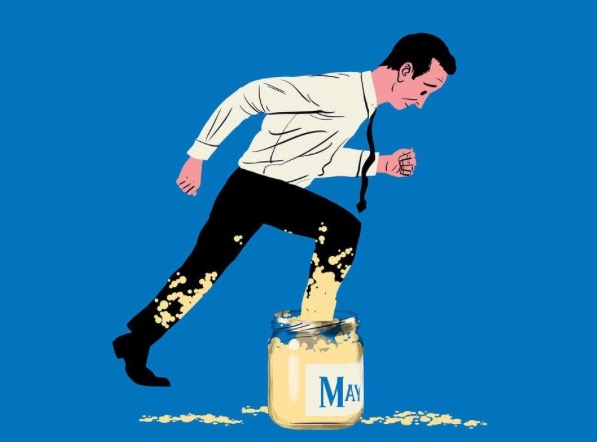
Economist reports on research on what motivates employees.
The story identifies six different archetypes, far too few to reflect the complexity of individuals but a lot better than a single lump of employees. “Pioneers” are the people on a mission to change the world; “artisans” are interested in mastering a specific skill; “operators” derive a sense of meaning from life outside work; “strivers” are more focused on pay and status; “givers” want to do work that directly improves the lives of others; and “explorers” seek out new experiences.
These archetypes are unevenly distributed across different industries and roles. Pioneers in particular are more likely to cluster in management roles. The Bain survey finds that 25% of American executives match this archetype, but only 9% of the overall us sample does so.
Click on the picture to play the full story.
Categories: Management | Psychology |
Posted on Feb 02, 22

China Innovation Capacity Growth Index 2015 and 2020
It is of interest in China and across the world to predict whether China will catch up with the most economically advanced nations in innovation capacity. To facilitate an ongoing assessment of China’s innovation capacity, the article develops a China Innovation Capacity Growth Index composed of eight separate measures. China’s performance in 2020 is compared to the baseline from 2015, showing that China has progressed in six of the eight measures. This article and the accompanying Technicalm Appendix explain each of the measures, including the sources for the data, and report
the changes in performance over time.
Download article here: China Innovation Capacity Growth Index 2015 and 2020
Categories: China | Innovation | Management |
Posted on Dec 04, 21

My Writings on Chinese Firms and Innovation in the Chinese Economy
I collected all my Writings on Chinese Firms and Innovation in the Chinese Economy in one place.
 .
.
Categories: China | Innovation | Publications | Writing |
Posted on Nov 14, 21

Excerpt from Last Interview with Jim March
Peter Ping Lee interviews James March. I provide here what I personally found the most interesting part of the full interview.
Peter: In your MOR 2005 article (March 2005), you referred to the peripheral position of the indigenous research communities relative to the mainstream research community. Do you think the Chinese research community is like that?
James: So far as possible, we would like to maintain some diversity. The ideology of research is international and sharing, but the risk is that you converge too completely and too fast. So how do you keep it from converging too rapidly and too completely? National and other communities being separate is our way to maintain diversity. It is a complicated problem because, from the point of the view of the separate community, that is not advantageous; they will be more advantageous if they converge with the dominant view; from the point of the view of the total community, there is an advantage having diversity. One of the ways to maintain that diversity in our present world situation is being national with a combination of separate cultures, separate languages, and some kind of local enthusiasm. Whether maintaining the optimum diversity is a much more complicated question, but a completely convergent is not optimum, so you need some diversity.
Peter: Is this analogous to the argument that if you don’t maintain exploration, then there is a tendency that the community will convert into exploitation?
James: It can be framed as exploitation-exploration issue. And that issue arises in all places, and in all places that I know, we have no optimum solution to it. We don’t know what the best mix is, but we know that is not the extremes. Diverse totally is not what you really want to be, but how much diversity you want is very complicated. Some parts are very simple. The longer you look ahead, the more you want diversity; the shorter your time perspective, the less you want diversity; that is fought over and over again. And some areas we have theorems that show that is true. The one I know best is the two-armed bandit world.
That is a set of problems that can be characterized as like going to a casino and confronting a whole array of slot machines. You know these slot machines have different payoffs. But you don’t know which one is the best, so you start experimenting. What is your search rule? After a while, you have found one that appears to be the best. And obviously, you will do well by repeating that rule. But when you repeat that one, you don’t search for any other ones. If you search for another one, you do less well in the short run, but you might do better in the long run. We don’t have any real solution to that problem. We do not know how to determine the optimum outcome.
Categories: China | Management | Methodology |
Posted on Oct 30, 21

How Philco-Ford imagined in 1967 what daily life would be like in 1999
According to Wikipedia, Ford owned Philco for 10 years starting in 1961. Hence the name Philco-Ford. The brand is now owned by Philipps.
Categories: Economics |
Posted on Mar 17, 21

A Fly on the Wall in a Fearless Organization
JPM: Amy Edmondson has written a very thoughtful short overview of what an organization that creates psychological safety for its employees without sacrificing performance looks like. I highly recommend the piece.
What does psychological safety sound like?
The trickiest part of organizational change is translating the big idea into the little interactions that happen hundreds or even thousands of times a day. What are team members actually saying to one another in situations both small and large, both ordinary and earth-shattering?
If you follow the current thinking on leadership and management, you have seen the concept of psychological safety cropping up with greater and greater frequency. Psychological safety describes an atmosphere where team members feel they can speak up with concerns, bad news, or ideas without fear of being shut down, blamed, or humiliated.
I call these cultures fearless organizations. In a fearless organization, people are all in. They don’t let concerns about what others might think cripple them. I’ve spent 20-plus years studying how psychologically safe workplaces unleash creativity, innovation, and learning, and have documented it all in my latest book, The Fearless Organization.
Where it gets complicated is bringing this into the everyday life of the team. First, my standard caveat: Psychological safety is often confused with a “safe space,” when it’s actually nearly the opposite.
A psychologically safe culture is not free of conflict, consequences, or accountability. These things exist but are managed positively and constructively. It does not mean employees are “wrapped in cotton wool,” as my friend and London Business School professor Dan Cable has said. Think of psychological safety as an atmosphere of healthy give-and-take, rather than an atmosphere of tiptoeing around.
So, in a psychologically safe environment, what’s actually being said in the room? I’ve divided the list below into “team leader” and “team member,” mainly for emphasis. But in actuality, anyone anywhere in the hierarchy can permit, build, or claim psychological safety. Team leader
- This is totally new territory for us, so I’m going to need everyone’s input.
- There are many unknowns/things are changing fast/this is complex stuff. So we will make mistakes.
- Okay, that’s one side. Let’s hear some dissent/who’s got something to add/let’s have some give-and-take.
- Lucy, you look concerned. Gilles, you haven’t said much. Adrian, what are you hearing in the warehouse/on the phones/on the road?
- What assumptions are we making? What else could this be/could we investigate/have we left out?
- What are you up against? What help do you need? What’s in your way?
- Did everything go as smoothly as you would have liked? What were the friction points? Are there systems we should retool?
- If you’ve got something to add, just… (mention a few channels of communication, including ones suitable for difficult conversations).
- Thank you for that clear line of sight. (This was the famous reaction of Ford’s Alan Mullaly to some colossally bad news.)
- I really appreciate your bringing this to me. I’m sure it wasn’t easy.
Team member:
- We’ve got some new information we’d like to share.
- Something’s been troubling me. Do you have ten minutes to talk about it?
- Some of this is not good news. Is this an okay time to dig in?
- I mentioned the problem to the team and we’ve got some ideas.
- I’ve hit a roadblock/I’ve got to go back to square one/I’ve made a mistake.
- We tried an experiment, and it didn’t go as expected.
- The front desk says patients aren’t comfortable with this new procedure.
- There’s been an uptick in X, and we can’t explain it just yet.
- I’m not sure who to approach about this kind of thing/the level of detail you like to hear/what’s the best procedure for bringing up a concern.
- Let me recheck that for you. It doesn’t sound right. It’ll only take a minute.
- We need another pair of eyes on this. Best to spend a minute/hour/day/week on that now.
- I don’t feel right about this. Can we do a hard stop right here?
- article continues after advertisement
As you can see, these are perfectly normal, everyday phrases. And that is exactly my point. None of this is technical knowledge or deep expertise; it’s more like cultivating a habit of mind and re-orienting one’s thinking. All of it is quite simple—and yet, not easy.
A few themes emerge from these snippets. Team leaders and members, wherever they are in the hierarchy, must continuously do three things:
- Frame the challenge. This creates room for questions and concerns, but also for creativity. What you’re really doing is giving permission to experiment, possibly mess up in myriad small ways, and thus to learn. After all, we live in a VUCA world (a military term for variable, uncertain, complex, and ambiguous). There’s always a challenge to frame.
- Invite participation. Make it 100 percent clear that all voices are welcome. Be continuously on the lookout for the unspoken concern or idea. It remains a stubborn fact that we don’t know what we don’t know. I’ve seen companies do creative things like developing their own insider-speak, almost a set of cues for speaking up. These can be anything—a catchphrase, a line from a movie. And depending on the context, they can be odd or goofy or profound.
- Respond appropriately. Make speaking up a positive experience, even when you don’t like what you’ve heard. This is incredibly hard sometimes, but absolutely necessary. When you get bad news, you might be angry or disappointed. You may be worried about the project or how the news reflects on you. But in the moment, you must put all that to the side. Thank the messenger enthusiastically, sincerely, and publicly, if appropriate. Then move forward constructively.
These three things must be done in as many ways—and at as many junctures—as it takes.
Here’s a way to think about creating psychological safety. It comes from a different context, but it works. There’s a very gifted designer of educational products, David Dockterman, who has taught a popular course at the Harvard School of Education. One of his maxims: Think of the classroom where kids are doing your activity. Think of what you want them to be saying to each other. Work backward from there.
It’s in that spirit that I offer up the list above. It only scratches the surface, and context is everything. But I do I hope these snippets might help you work backward to a culture of speaking up and forward to a fearless organization.
Source: Psychology Today
Categories:
Posted on Dec 23, 20

Categories: Biographies |
Posted on Dec 15, 20

225 Zufällige Worte (225 Random Words in German) für Brainstorming
Hier sind 225 zufällig Worte. Man kann sie auch als Excel Tabelle herunterladen.
Erwachsener
Flugzeug
Luft
Flugzeugträger
Luftwaffe
Flughafen
Album
Alphabet
Apfel
Arm
Categories: Design Thinking | Topics | Creativity |
Posted on Nov 29, 20

McDonald’s finds success with going back to basics
The Economist reports:
The seeds of the revival of McDonald’s started with a simple decision that is surprisingly easy to get wrong: go back to basics. From 2015 onwards, it pared back its array of menu offerings and focused on price and quality. It recommitted to Ray Kroc’s beloved business model, increasing the share of franchises last year to 93% (of almost 39,000 restaurants), up from 82% in 2015. That provided it with higher-margin and steadier royalty and rental income. It streamlined its sprawling international operations, selling control of its restaurants in China and Hong Kong. The results were impressive. Across McDonald’s sales exceeded $100bn last year; its operating margins, thinner than a frazzled patty in most of the restaurant industry, ballooned to 43%. And its share price sizzled. Since 2015 its market value has almost doubled to $160bn.
Full Story at Economist.com
Categories: Strategy Evolution: Historical Firm Cases | Firm Histories | Strategic Management 4 | Topics | Turnarounds |
Posted on Nov 17, 20
Peter Hessler: “How China Controlled the Coronavirus”
The China expert Peter Hessler has written an informative letter on How China Controlled the Coronavirus drawing on his experience on teaching a class on non-fiction writing in Sichuan during the pandemic. Read Article. You can listen to a podcast of the article as well.
Categories: China | Publications |
Posted on Oct 02, 20

Review of “Bubbles and Crashes” by Brent Goldfarb and David A. Kirsch
Brent Goldfarb and David A. Kirsch. Bubbles and Crashes: The Boom and Bust of Technological Innovation. Stanford, CA: Stanford University Press, 2019. 247 pp. $35.00, cloth.
Financial bubbles have been a recurring phenomenon throughout the history of capitalism that have proved costly for society. According to the U.S. Bureau of Economic Analysis, the most recent financial crisis from 2007 to 2009 resulted in a real GDP loss of $650 billion. The U.S. Government Accountability Office (2013: 12) called it the “most severe economic downturn since the Great Depression of the 1930s.”
Given that financial bubbles are more the domain of finance scholars and economists, why should ASQ readers read a book on Bubbles and Crashes? Its subtitle—The Boom and Bust of Technological Innovation—is what makes the book interesting for organizational scholars. Beginning with the famous Aston studies, organizational scholars have increasingly focused on technology as a key shaper, first of individual organizations (Hage and Aiken, 1969) and later of entire populations of organizations (Tushman and Anderson, 1986). The recent interest in “disruption” typically involves a new technology that a startup develops for a niche market. Subsequently the technology is so much improved that the startup can bring it to the core market where it disrupts the leadership position of incumbent firms (Christensen, 1997). Goldfarb and Kirsch extend this literature by examining the role of technological innovation in the formation of bubbles in financial markets. They aim to identify the key causal mechanisms that increase the likelihood of the formation of a speculative bubble.
The book is divided into six chapters. After a brief introduction outlining the most important elements of their theory about the formation of speculative bubbles, chapter 1 introduces the central concepts necessary to differentiate bubbles from non-bubbles. Bubbles are those “boom and bust episodes in which investors drive up prices and get fooled” (p. 24). To determine whether there is a bubble, the authors develop a measure called “frothiness” that represents “the number of standard deviations from the predicted stock or index trend . . . where the ‘trend’ is the predicted stock price looking forward and backward seven years” (p. 35). In short, the measure indicates whether stock prices are inflated. If the frothiness is larger than 2, the stock price is a candidate for a bubble, but the authors bring to bear additional judgments to determine whether investors were fooled. Chapter 2 describes the role of uncertainty and narratives in the formation of bubbles. The authors differentiate four types of uncertainty: technological uncertainty, competitive uncertainty, business model and value chain uncertainty, and demand uncertainty. And they conceptualize narratives—which emerge in an unexpected starring role in the book––as “temporally sequenced accounts of interrelated events or actions undertaken by characters” (p. 51). Chapter 3 explains what role novices, naïfs, and biases play in the formation of bubbles. While chapters 2 and 3 constitute Goldfarb and Kirsch’s theory on the causes of speculative bubbles driven by technological innovation, chapter 4 applies their framework to a sample of technologies to test its explanatory power. In chapter 5 Goldfarb and Kirsch test the external validity of their theory by applying the framework to a different sample of more recent technologies. Chapter 6 derives policy implications from the framework and gives practical advice on how one can assess the probability of being in a bubble. The appendix provides further information on the methods, a summary of the main findings in tables, and a comprehensive list of sources used for writing the detailed histories of the technologies.
Categories:
Posted on May 27, 20
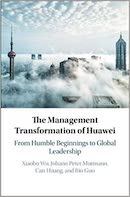
The Management Transformation of Huawei: From Humble Beginnings to Global Leadership
Huawei has become China’s most prominent multinational company and a leader in the ICT sector. Given unprecedented access to the company, the authors of this book examine the management transformation of Huawei from its inception in 1987 until 2019, observing in detail not only the creation of its organizational routines but also the breaking of routines across most major functional areas: Management, Product Development, HR, Supply Chain, Finance, R&D, Intellectual Property, and International Business. ‘Dynamic capabilities’ are central to theories of competitive advantage and this book highlights Huawei as an ideal case study for the successful implementation of change routines and change-supporting values. The chapters cover all the major change initiatives the firm has undertaken since 1996 to import best practices from the West, with the help of consultants. The insights presented in the book will be particularly interesting for academics in the field of strategy, management, and business history.
Table of Contents and ordering

Endorsements
‘This is a ‘must read’ book for whoever is interested in the rise of China. It provides unique empirical and conceptual insights on China’s leading company and draws on world class researchers for analysis and commentaries. Uniquely valuable!’
—Yves Doz, Solvay Chaired Professor of Technological Innovation, INSEAD
‘The Management Transformation of Huawei provides a fascinating account of how Huawei preserved its entrepreneurial spirit as it rapidly scaled up over its 30-year history. Very few studies provide such an in-depth historical account of the evolution of a company over such a long period of time. Any scholar or practitioner interested in understanding the leadership challenges that arise with rapid organizational growth should read this book.’
—Ranjay Gulati, Paul R. Lawrence MBA Class of 1942 Professor of Business Administration, Harvard Business School
‘Huawei has become a major player in the global electronics industry and has been - perhaps unwantedly - cast into the role of a significant geopolitical force. This book is important and interesting because of the astonishing story of Huawei’s corporate growth. The authors provide an insightful account of how Huawei transformed itself from a small startup into a global giant, making an important scholarly contribution under major headings of the strategic management literature, such as ‘knowledge’, ‘routines’ and ‘dynamic capabilities’.’
—Sidney G. Winter, Deloitte and Touche Professor Emeritus of Management, Wharton School, University of Pennsylvania
Cambridge University Press Book page
Categories: Bookshelf | China | Innovation | Management | Publications | Writing |
Posted on Apr 07, 20

Striking Similarities to Spanish Flue outbreak in 1918
We have heard about the similarities of COVID-19 to the Spanish flue, but here is it told well in a short video.
Categories:
Posted on Mar 21, 20

Why gave hydrogen-powered car not become mainstream even though they were hyped in already in 1974
GM had a hydrogen-powered bus in 1967. VW and Mercedes had experimental hydrogen-powered cars in mid-1970s. Here is a list of vehicles produced by various companies. WSJ.com has produced a great video explaining why hydrogen cars are still not around the corner, despite the technology’s great promise.
Categories: Innovation | Management |
Posted on Jan 22, 20

VW CEO uses history to explain why VW needs to speed up change to avoid the fate of Nokia
This is a Deepl AI translation of the speech of VW CEO to employees in January 2029. The complete speech of the VW boss in the wording:
“Ladies and gentlemen,
the world is on the move. Politically and technologically, we live in an incredibly dynamic time. A turn of an era stands before us - from the dimension of the industrial revolution. And Volkswagen is in the midst of the storm of the two greatest transformation processes:
- Climate change and the associated pressure to innovate towards emission-free driving.
- And digitalisation, which is fundamentally changing the automobile as a product.
Our Group is not always in the best position to react quickly and systematically enough to these developments. Measured against this, we have not done badly so far. This is also acknowledged by market observers. In 2019 in particular, analysts have gained new confidence in our strategy.
At the beginning of this year, Kepler Cheuvreux attested: “We think VW is the best positioned player in the industry to master the CO2 challenge. And Goldman Sachs says: “We expect VW Group to continue to prosper this year as a result of ongoing positive sales developments at VW brand, a pick-up in sales at Audi, and broadly flat margins.
In the Litigation area, we are making the risks from the diesel crisis more manageable step by step. In terms of corporate culture, we are seeing tangible and measurable progress. I am pleased that we have increased our integrity by three points in the sentiment barometer.
Our modern MQB-based model range in terms of volume and the new Porsches, Audis, Lamborghinis and Bentleys are convincing customers. We are improving the quality of our business. Revenue and earnings are growing faster than unit sales. In China, we increased our market share by 1.4 percent in a sharply declining market. This is a great achievement, which hardly anyone would have expected from us. Congratulations to Stephan Wöllenstein and his team on their outstanding performance!
In South America we are back in the black for the first time, and we have also turned our business around in Russia. In North America, we have significantly improved our earnings and are aiming to break even this year. Volkswagen Financial Services will have a record year in 2019, and the component has taken decisive steps in battery development and production.
At Audi, the e-tron got off to a successful start, development costs were reduced and a comprehensive cost reduction programme was launched. Porsche has once again delivered excellent figures and cars and set an example with the Taycan. Seat conquers new and young customers with Cupra. Skoda is running at full speed and will present the new models in India, an important future market for us, at the beginning of February.
VW Commercial Vehicles has put the extremely important Ford cooperation on track, and Traton has completed its IPO. We are seeing positive trends at Bentley, Ducati, Bugatti and Lamborghini, and Bentley in particular is back in the black. The Volkswagen core brand has worked hard to further increase returns. All in all: good developments.
“The storm is just beginning”
Categories: Management |
Posted on Jan 21, 20

Framework and Toolkit for Improving Peripheral Strategic Vision
Day and Shoemaker have developed a useful framework and toolkit for assessing how much peripheral strategic vision your company needs.

An MIT Sloan article lays out the ideas in three steps.

More details on the toolkit are in their HBR article that can be assessed here.
Categories: Bookshelf | Management |
Posted on Jan 19, 20

