

The content management system powering this website is over 20-years old. The https version of it is not working properly. Take out “s” in the from https and with http: the website is still working. Bear with us us we are migration the website to a modern CMS.
Peter Murmann January 2026
Return to Categories:
Posted on Jan 28, 26


Research Focus on Auto Industry
My research team is interested in studying how to improve strategic forecasting ability. As a key empirical context, we have selected the auto industry undergoing dramatic technological changes.

Click on the picture to access auto-future.org
Return to Categories: Innovation | Management |
Posted on Apr 11, 24

New Competition in the auto industry: Incumbents versus startups
I have two new publications about the new competition in the auto industry.
A Capabilities Framework for Dynamic Competition: Assessing the Relative Chances of Incumbents, Start-Ups, and Diversifying Entrants (with Fabian Vogt in Management and Organization Review)
Exploring the structure of internal combustion engine and battery electric vehicles: implications for the architecture of the automotive industry (with Benedikt Schuler in Industrial and Corporate Change)
Return to Categories: Innovation | Management | Writing |
Posted on Feb 15, 23

Forum on ‘The Rise of China’s Digital Economy’
In this forum, we present three essays that collectively seek to document and explain the rise of China’s digital economy. The first essay written by Hong Jiang – who is based in China – and myself – who is based in the West – focuses on documenting the rise of China’s digital economy by comparing it systematically with developments in the United States (Jiang & Murmann, 2022). This first essay intentionally says relatively little about the causes driving the rise so that the two invited teams of commentators could focus on reasons behind the growth of e-commerce and internet services in China. The first team, composed of Chong Ma, Ji-Ye Mao, and Xiao-Peng An (2022), is based in China and the second team, composed of Martin Kenney and Arie Y. Lewin (2022), is based in the United States. Both teams were provided with the opening essay and a set of questions to stimulate a debate about causes.
• Is the increasing strength of these digital sectors intimately tied to government policies? If so, how?
• Is the fact that China is much more lax about privacy a critical reason for the advances in China?
• Will China overtake the US in these digital services or will the fast growth slowdown?
• On the assumption that the geopolitical struggles between China and the US continue to rise, what, if any implications will this have for the further development of e-commerce and digital services companies in China and the US?
• The Chinese government recently has made it more difficult for Chinese firms to list on US stock exchanges; will this have a negative impact?
Return to Categories: China | Innovation | Economics |
Posted on Oct 02, 22

China Innovation Capacity Growth Index 2015 and 2020
It is of interest in China and across the world to predict whether China will catch up with the most economically advanced nations in innovation capacity. To facilitate an ongoing assessment of China’s innovation capacity, the article develops a China Innovation Capacity Growth Index composed of eight separate measures. China’s performance in 2020 is compared to the baseline from 2015, showing that China has progressed in six of the eight measures. This article and the accompanying Technicalm Appendix explain each of the measures, including the sources for the data, and report
the changes in performance over time.
Download article here: China Innovation Capacity Growth Index 2015 and 2020
Return to Categories: China | Innovation | Management |
Posted on Dec 04, 21

My Writings on Chinese Firms and Innovation in the Chinese Economy
I collected all my Writings on Chinese Firms and Innovation in the Chinese Economy in one place.
 .
.
Return to Categories: China | Innovation | Publications | Writing |
Posted on Nov 14, 21

Excerpt from Last Interview with Jim March
Peter Ping Lee interviews James March. I provide here what I personally found the most interesting part of the full interview.
Peter: In your MOR 2005 article (March 2005), you referred to the peripheral position of the indigenous research communities relative to the mainstream research community. Do you think the Chinese research community is like that?
James: So far as possible, we would like to maintain some diversity. The ideology of research is international and sharing, but the risk is that you converge too completely and too fast. So how do you keep it from converging too rapidly and too completely? National and other communities being separate is our way to maintain diversity. It is a complicated problem because, from the point of the view of the separate community, that is not advantageous; they will be more advantageous if they converge with the dominant view; from the point of the view of the total community, there is an advantage having diversity. One of the ways to maintain that diversity in our present world situation is being national with a combination of separate cultures, separate languages, and some kind of local enthusiasm. Whether maintaining the optimum diversity is a much more complicated question, but a completely convergent is not optimum, so you need some diversity.
Peter: Is this analogous to the argument that if you don’t maintain exploration, then there is a tendency that the community will convert into exploitation?
James: It can be framed as exploitation-exploration issue. And that issue arises in all places, and in all places that I know, we have no optimum solution to it. We don’t know what the best mix is, but we know that is not the extremes. Diverse totally is not what you really want to be, but how much diversity you want is very complicated. Some parts are very simple. The longer you look ahead, the more you want diversity; the shorter your time perspective, the less you want diversity; that is fought over and over again. And some areas we have theorems that show that is true. The one I know best is the two-armed bandit world.
That is a set of problems that can be characterized as like going to a casino and confronting a whole array of slot machines. You know these slot machines have different payoffs. But you don’t know which one is the best, so you start experimenting. What is your search rule? After a while, you have found one that appears to be the best. And obviously, you will do well by repeating that rule. But when you repeat that one, you don’t search for any other ones. If you search for another one, you do less well in the short run, but you might do better in the long run. We don’t have any real solution to that problem. We do not know how to determine the optimum outcome.
Return to Categories: China | Management | Methodology |
Posted on Oct 30, 21

Review of “Bubbles and Crashes” by Brent Goldfarb and David A. Kirsch
Brent Goldfarb and David A. Kirsch. Bubbles and Crashes: The Boom and Bust of Technological Innovation. Stanford, CA: Stanford University Press, 2019. 247 pp. $35.00, cloth.
Financial bubbles have been a recurring phenomenon throughout the history of capitalism that have proved costly for society. According to the U.S. Bureau of Economic Analysis, the most recent financial crisis from 2007 to 2009 resulted in a real GDP loss of $650 billion. The U.S. Government Accountability Office (2013: 12) called it the “most severe economic downturn since the Great Depression of the 1930s.”
Given that financial bubbles are more the domain of finance scholars and economists, why should ASQ readers read a book on Bubbles and Crashes? Its subtitle—The Boom and Bust of Technological Innovation—is what makes the book interesting for organizational scholars. Beginning with the famous Aston studies, organizational scholars have increasingly focused on technology as a key shaper, first of individual organizations (Hage and Aiken, 1969) and later of entire populations of organizations (Tushman and Anderson, 1986). The recent interest in “disruption” typically involves a new technology that a startup develops for a niche market. Subsequently the technology is so much improved that the startup can bring it to the core market where it disrupts the leadership position of incumbent firms (Christensen, 1997). Goldfarb and Kirsch extend this literature by examining the role of technological innovation in the formation of bubbles in financial markets. They aim to identify the key causal mechanisms that increase the likelihood of the formation of a speculative bubble.
The book is divided into six chapters. After a brief introduction outlining the most important elements of their theory about the formation of speculative bubbles, chapter 1 introduces the central concepts necessary to differentiate bubbles from non-bubbles. Bubbles are those “boom and bust episodes in which investors drive up prices and get fooled” (p. 24). To determine whether there is a bubble, the authors develop a measure called “frothiness” that represents “the number of standard deviations from the predicted stock or index trend . . . where the ‘trend’ is the predicted stock price looking forward and backward seven years” (p. 35). In short, the measure indicates whether stock prices are inflated. If the frothiness is larger than 2, the stock price is a candidate for a bubble, but the authors bring to bear additional judgments to determine whether investors were fooled. Chapter 2 describes the role of uncertainty and narratives in the formation of bubbles. The authors differentiate four types of uncertainty: technological uncertainty, competitive uncertainty, business model and value chain uncertainty, and demand uncertainty. And they conceptualize narratives—which emerge in an unexpected starring role in the book––as “temporally sequenced accounts of interrelated events or actions undertaken by characters” (p. 51). Chapter 3 explains what role novices, naïfs, and biases play in the formation of bubbles. While chapters 2 and 3 constitute Goldfarb and Kirsch’s theory on the causes of speculative bubbles driven by technological innovation, chapter 4 applies their framework to a sample of technologies to test its explanatory power. In chapter 5 Goldfarb and Kirsch test the external validity of their theory by applying the framework to a different sample of more recent technologies. Chapter 6 derives policy implications from the framework and gives practical advice on how one can assess the probability of being in a bubble. The appendix provides further information on the methods, a summary of the main findings in tables, and a comprehensive list of sources used for writing the detailed histories of the technologies.
The core idea of the book is that the interaction between (1) the uncertainty pertaining to the potential of a particular technological innovation, (2) powerful positive narratives that shape investors’ beliefs about a technological innovation, (3) novice investors, and (4) so-called “pure plays” that enable investors to directly invest in a technological innovation increases the probability that bubbles form. What surprised us the most in the book is that narratives play a central role in the formation of bubbles. In the face of uncertainty, narratives serve as a means of sensemaking for novice investors to understand a new technology’s potential (Gioia and Chittipeddi, 1991). If novice investors buy into the narratives about a new technology, they are much more likely to invest in it by buying stocks of a “pure play”––a new firm that exists only to commercialize the new technology. They drive up the prices of the pure play stocks, making the formation of a bubble more likely. Tesla offers a current example of a powerful narrative that can drive the stock price to staggering heights. Tesla in 2019 sold only 368,000 cars, compared with GM selling 7.71 million. But even though GM sold 20 times as many cars as Tesla that year, in January 2020 GM’s stock was worth $50 billion and Tesla’s was worth $93 billion (Lee, 2020). The present positive Tesla narratives run like this: The car industry will have to switch in the next few years to e-vehicles to meet emissions targets. Tesla can get exciting cars out the door and now has proved that it can also mass produce these cars. Incumbent players are slow to change, and so Tesla will capture a very large market share in the coming years.
We found the book a fascinating read because it provides a role model for how the understanding of a phenomenon can be advanced through the interplay of ideas and evidence. Goldfarb and Kirsch marry historians’ sensibility with sophisticated social science methodology.
First, drawing on their historical expertise, they develop well-researched histories of all important new technologies since the mid-19th century. Although the histories were too long to print in the book, the reader can sense that the authors have carefully researched the innovations when they write about electric lighting (p. 17), the telephone (p. 26), insulin (p. 29), radio (pp. 31, 64), television (p. 33), commercial aviation (pp. 57, 116), vulcanized rubber (pp. 59, 87), the internal combustion engine (p. 67), the automatic watch (p. 105), phototype printing (p. 106), antibiotics (p. 108), hosiery (p. 108), the jet engine (p. 114), the Wankel engine (p. 118), the transistor (p. 123), oil drilling (p. 128), cortisone (p. 128), the internet (p. 134), personal computers and laptops (p. 143), liquid crystal displays (p. 146), laparoscopic surgery (p. 148), housing (p. 152), and Tesla and e-vehicles (p. 156). To make their conclusions as transparent as possible, Goldfarb and Kirsch invite readers to check and replicate their analyses, as the authors have made their data publicly available on the book’s website (https://www.sup.org/books/extra/?id=24950&i=Online%20Appendix.htm) and as they are willing to share upon request all the detailed histories. Second, the authors test-drive their framework across a large sample of technologies spanning nearly 150 years. These technologies are carefully selected across all industries to avoid a sampling bias. Third, Goldfarb and Kirsch cross-validate their framework by applying it to a second sample of more-recent technological innovations, providing further support for their framework. Fourth, to avoid confirmation bias they also test whether their framework correctly explains and predicts when a technological innovation did not result in the formation of a bubble.
Key Causal Factors Driving Bubbles in New Technology Markets
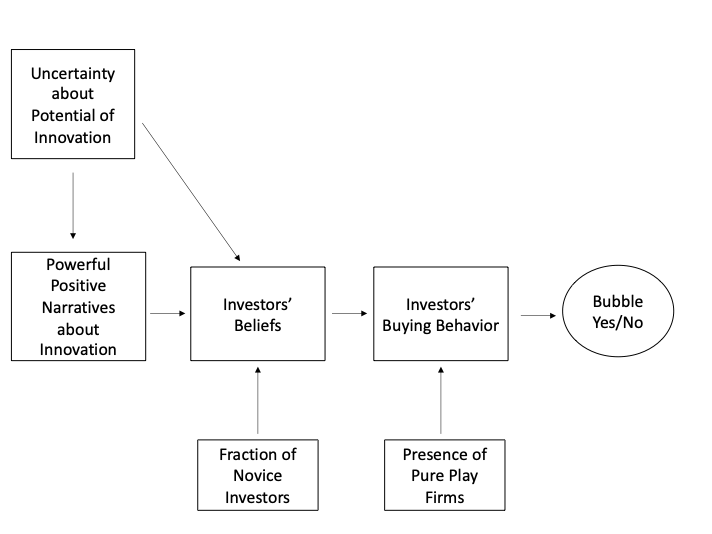
We have a minor criticism that the authors could remedy when the paperback version of the book is published. Organizational scholars—for better or worse—are used to having graphical summaries of the main theoretical arguments because they have been socialized by journals, such as the Academy of Management Review and ASQ. It would be nice to have a graphical summary of the theory in the book’s introduction to which the reader can return when the authors provide details of their ideas in later chapters. We felt a bit lost in later chapters and created the figure above for our own orientation.
No single piece of research can provide definitive support for a theory, and every methodology has its shortcomings. Goldfarb and Kirsch provide support for the theory’s external validity by examining counterfactuals of different technological innovations that did not lead to a bubble. If one wants to provide the most compelling causal evidence, it would be necessary to observe counterfactuals of the same technological innovation to demonstrate the causal effect of, for example, narratives on the formation of bubbles. This of course is not possible with historical data.
A next step in the research agenda in our view would be history-friendly simulations in which one can create exact counterfactuals in the simulations process and determine whether key causal factors hold. See, for example, the simulations by Brenner and Murmann (2016), who tested causal arguments made in a historical analysis by Murmann (2003). Another next step would be to build an experimental stock market (one can do these easily with university students), vary the availability of narratives while holding everything else constant, and observe whether bubbles form or not.
Overall, we highly recommend Bubbles and Crashes to anyone who is either interested in how technological innovations and narratives shape industry developments or who simply seeks inspiration and guidance on how to combine historical and social science methodologies.
Johann Peter Murmann and Benedikt Schuler
Return to Categories:
Posted on May 27, 20
The Management Transformation of Huawei: From Humble Beginnings to Global Leadership
Huawei has become China’s most prominent multinational company and a leader in the ICT sector. Given unprecedented access to the company, the authors of this book examine the management transformation of Huawei from its inception in 1987 until 2019, observing in detail not only the creation of its organizational routines but also the breaking of routines across most major functional areas: Management, Product Development, HR, Supply Chain, Finance, R&D, Intellectual Property, and International Business. ‘Dynamic capabilities’ are central to theories of competitive advantage and this book highlights Huawei as an ideal case study for the successful implementation of change routines and change-supporting values. The chapters cover all the major change initiatives the firm has undertaken since 1996 to import best practices from the West, with the help of consultants. The insights presented in the book will be particularly interesting for academics in the field of strategy, management, and business history.
Table of Contents and ordering

Endorsements
‘This is a ‘must read’ book for whoever is interested in the rise of China. It provides unique empirical and conceptual insights on China’s leading company and draws on world class researchers for analysis and commentaries. Uniquely valuable!’
—Yves Doz, Solvay Chaired Professor of Technological Innovation, INSEAD
‘The Management Transformation of Huawei provides a fascinating account of how Huawei preserved its entrepreneurial spirit as it rapidly scaled up over its 30-year history. Very few studies provide such an in-depth historical account of the evolution of a company over such a long period of time. Any scholar or practitioner interested in understanding the leadership challenges that arise with rapid organizational growth should read this book.’
—Ranjay Gulati, Paul R. Lawrence MBA Class of 1942 Professor of Business Administration, Harvard Business School
‘Huawei has become a major player in the global electronics industry and has been - perhaps unwantedly - cast into the role of a significant geopolitical force. This book is important and interesting because of the astonishing story of Huawei’s corporate growth. The authors provide an insightful account of how Huawei transformed itself from a small startup into a global giant, making an important scholarly contribution under major headings of the strategic management literature, such as ‘knowledge’, ‘routines’ and ‘dynamic capabilities’.’
—Sidney G. Winter, Deloitte and Touche Professor Emeritus of Management, Wharton School, University of Pennsylvania
Cambridge University Press Book page
Return to Categories: Bookshelf | China | Innovation | Management | Publications | Writing |
Posted on Apr 07, 20

Why gave hydrogen-powered car not become mainstream even though they were hyped in already in 1974
GM had a hydrogen-powered bus in 1967. VW and Mercedes had experimental hydrogen-powered cars in mid-1970s. Here is a list of vehicles produced by various companies. WSJ.com has produced a great video explaining why hydrogen cars are still not around the corner, despite the technology’s great promise.
Return to Categories: Innovation | Management |
Posted on Jan 22, 20
China
Lectures
Conferences
Entrepreneurship
Innovation
Economics
Management
Methodology
Psychology
Publications
Writing

