

Guy Kawasaki on Lessons he Learned from Steve Jobs
PM: Guy also shows how to put together a great simple slide presentation.
Return to Categories:
Posted on Oct 02, 13

Announcing a Special Feature: “Letters from China”
During the first two weeks of June, I will visit China for the first time. To share my impressions, I plan to write a few Letters from China. Today I want to give you a bit background on the trip. For a long time, I wanted get out behind my desk and see China with my own eyes. This visit is long overdue given that I started to research the development of the Chinese synthetic dye industry five years ago.
The goal of my visit is to get a deeper understanding of what the future of China will likely look like. More specifically, I want to become more knowledgeable about whether China will become the world leader in high-tech industries and if so how. For this reason, I want to build connections with people in China who are participating in or following these developments. Until now I have been relying on Hong Jiang to be my eyes in China. I recruited her from China to write her doctoral thesis under my supervision. Together we published an article entitled Regional institutions, ownership transformation, and migration of industrial leadership in China, showing how the leading centers of synthetic dye production industry shifted twice in the period from 1978 to 2008 because of differences in the institutional composition of regions within China. Hong is currently back in the field trying to find more evidence on how personal networks allowed entrepreneurs to access crucial knowledge from established firms. Our particular challenge is to find knowledgeable people from companies that went out of business so we can establish with more certainty that they lacked the personal contacts that allowed their rivals to be more successful.
It is important to realize that synthetic dye technology was developed in the West decades ago and has become stagnant. This is why Chinese firms could become the largest producers in the world by simply imitating product innovations made abroad. Now, I am looking for one or more industries where Chinese firms are not simply copying innovations made abroad but where they are at the frontier of global knowledge. If you think you know such an industry, please contact me. After my trip to China, I hope to have a better sense of the kind of high-tech industries in which China may be pushing the global knowledge frontier.
To avoid false expectations, let me emphasize that I am not writing my Letters from China as a “China expert.” I am very well versed in Western social theory and, more specifically, evolutionary theory in the social sciences: As an evolutionist, I have strong theoretical commitment that success is built on a mountain of failures. Or, to put it more simply: China cannot become the leader in a sector without trying out many things and figuring out what works through experience. (I lay out this perspective in non-technical terms in Scaffolding in Economics, Management, and the Design of Technologies). But I have modest credentials regarding the “facts on ground” in China. Aside from what Hong Jiang taught me, I can trace most of my knowledge about China to three books that I found particularly useful.
Between the Eagle and the Dragon: Who is Winning the Innovation Race? (2013) by Thomas Barlow
This book is hot off the press. Barlow asks a similar question that I am interested in: will China replace the USA as the leading economy by becoming the chief motor of innovation in the world economy? The audience for this book is primarily policy markers in countries of the Western Pacific Region who have to decide whether to align themselves primarily with the USA or the China. Barlow offers a well-researched and balanced view, spelling out in detail why at this stage it is impossible to predict whether the Chinese economy will overtake the U.S. by developing radically new technologies. For my own purposes, I found chapter 4 most useful. Here Barlow picks apart in detail statistics on global science publications and patents to assess how Chinese innovative capacity has developed over the past two decades. By 2009, for example, China had become No. 2 in the world (behind the USA) in the production of scientific articles, and has even overtaken the USA in the chemistry and physics (p. 85, Kindle Location 880). Barlow argues that patent statistics show that the large number researchers that China now employs are mainly focused on low-tech areas (p. 98, Kindle Location 1022). The big question, however, is whether this will remain so in the future years. This will be one of my key questions for my upcoming research on Chinese industries.
The Chinese Economy: Transitions and Growth (2007) by Barry J. Naughton
If you want to get a overview of the transformation of the Chinese economy since 1978, this should be your first stop. Barry Naughton is an expert on the Chinese economy who has been teaching at University of California, San Diego, for 25 years. When I was in high school in Germany, we learned a great deal about the USA because the country that dominated the world-order in the West, but we learned almost nothing about China. In the book, you learn that the China is similar in size to the U.S. and, even in regard to the variety of climate zones, has similar make-up to the USA. China, however, is a lot more rugged than the USA and a lot of that land is inhospitable (Kindle Location 353). Naughton devotes the early pages of his book to explain the organization the Chinese economy before 1949. One reason why Chinese economic development was so rapid when the communist party decided to abandon full-scale central planning in 1978 is that the country had a strong tradition of entrepreneurship and global trade already in the 2nd half of the 19th century. Naughton, for example, reports that a million households ventured in the tea industry, selling to hundreds of tea factories that exported across globe. It becomes quite apparent that the communist era from 1949 to 1978 is an aberration in the traditions of China and that the rapid growth was possible because the communist rulers could re-enlist an entrepreneurial tradition that was rampant before the communist took over. What I found fascinating is how often the Chinese rulers made fundamental changes to their economic policies even between 1949 and 1978. Political gridlock—for better or worse—has not been China’s problem for a long time.
My Country, My People (1935) by Lin Yuting
After I sent Hong Jiang a couple of New Yorker articles in 2009 and asked her whether they were accurate about Chinese social life, she told me “Peter, if you really want to understand the Chinese people, you have to read My Country, My People”. When she returned from one of her field research trips in China, she brought me a English copy of the book, which last month was made available as Kindle book. Lin Yuting’s father was Christian minister. In his quest to sort out the big question in life, Yuting examined Taoism and Buddhism in depth. After studying in Shanghai, he entered the doctoral program Harvard and later spent most of his life in the U.S. He wrote My Country, My People to explain China to Western people. I sparingly use the word “brilliant.” After reading a first couple of chapters you realize that this man is brilliant. He gives you a breathtaking overview of Chinese history, philosophy and culture and how China is different from the Christian West. Having read the book, I feel I have a good understanding of Chinese basic attitudes to life. You get an appreciation why family is the central unit of social organization and why Chinese have much lower expectations than Europeans or Australians that the state should provide many social functions. The notion of a Christian afterlife is entirely foreign to the Chinese mind. The focus of Chinese philosophy is to have a happy life here and now and not to get one’s expectations too high in this case these hopes are dashed. Even if you are an atheist but grew up in Europe or United States, you have a Judeo-Christian rhythm of social life built into your expectations. Can you imagine a western government announcing that to provide a more convenient holiday schedule adjacent to a public holiday that will occur Wednesday, June 12, everyone will get Monday and Tuesday off and instead work on Saturday and Sunday? Work on Sunday for everyone, really? I contend that not even in the USA where people are working much longer hours than in Europe, and where most shops are open on Sunday would that be possible any time soon. No problem in China. I am scheduled to meet with university staff in Shanghai all day Sunday and then I will be on holiday from Monday to Wednesday, only to resume my meeting on Thursday and Friday.
So stay tuned for my first Letter from China in early June. It will come from Beijing, the first stop of my trip. Last but not least, let me invite you to comment on my Letters from China either publicly by posting a comment on my Facebook page or privately by sending me an email.
Return to Categories: China | Innovation |
Posted on May 29, 13
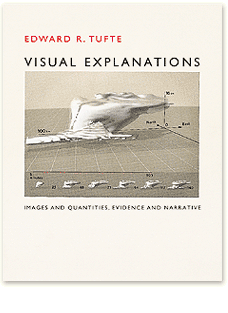
How to tell stories in graphical way
With his books on how to present data in a graphical way, Edward Tufte has taught many of us to be more creative in how we try to communicate a story based on quantitative data. Here is a short video that explains the power of communicating complex data in a graphical way. Tufte appears in the video.
Return to Categories: Lectures | Psychology |
Posted on May 17, 13

Gonski is a towering figure of Australian life. But his ideas of leadership apply everywhere in the Western world. To appreciate a bit more Gonski’s words, read this profile on him.
Return to Categories: Management | Psychology |
Posted on May 09, 13

Daniel Kahneman: The riddle of experience vs. memory
This is a very thought-provoking Ted talk on happiness and how we construct our judgement of happiness. TED summarizes: Using examples from vacations to colonoscopies, Nobel laureate and founder of behavioral economics Daniel Kahneman reveals how our “experiencing selves” and our “remembering selves” perceive happiness differently.
One of the interesting facts that he reports based on a Gallup survey of Americans is this: People who make more than $60,000 do not experience more happiness as they make more money. Above this threshold, money does not make you happy. Below this threshold ever dollar less will make decrease your experience of happiness. This leads Kahneman to remark: “Money does not buy happiness. But lack of money causes misery.”
Return to Categories: Psychology |
Posted on Apr 30, 13

Jeff Bezos on how to build organizations for innovation
Here are Bezos thoughts on n how to build organizations for innovation:
A willingness to fail and to be misunderstood “then what you can do is you can ramp up your rate of experimentation”. “So successful inventions [are] inventions that customers care about. It’s actually relatively easy to invent things that customers don’t care about, but successful invention, if you want to do a lot of that, you basically have to increase your rate of experimentation.
“And that you can think of as a process: how do you go about organising your systems, your people, all of your assets, your own daily life and how you spend time, how do you organise those things to increase your rate of experimentation because not all of your experiments are going to work.”
Bezos advice for aspiring entrepreneurs is “never chase the hot thing”. “That’s like trying to catch the wave, and you’ll never catch it. You need to position yourself and wait for the wave.”
From CIO Magazine
Return to Categories: Entrepreneurship | Innovation |
Posted on Dec 01, 12

The Hollywood movies about Facebook gave us an outline of the history Zuckerberg and the firm he founded. While this BBC documentary retells some of the facts from the Hollywood film, it brings to light many other interesting features of the facebook phenomenon.
Return to Categories: Innovation | Psychology |
Posted on Nov 21, 12

10 Management insights courtesy of Carol Tice
Carol Tice summarized the 10 lessons in recent management books.
1. Instead of hiring people with fancy resumes, hire people who fit your culture and are teachable.
2. Build a strong brand and don’t change it.
3. Focus all your products on the consumer by studying and listening to customers and innovating accordingly.
4. Appoint a DRI, or Directly Responsible Individual, for every task.
5. Create a confrontational workplace culture where workers feel free to challenge others’ opinions.
6. Have a system of secrecy that builds excitement and a sense of ownership—from launching projects in an outbuilding that flies a pirate flag to erecting walls around off-limits “lockdown rooms.”
7. Create a recognition culture. Novak was once horrified to find a 30-year company executive who only heard how great people thought his contributions were a few weeks before his retirement. Now, Yum! managers all over the world give out unique recognition awards, from miniature Taj Mahal statues to rubber chickens.
8. To lead people and achieve big goals, ask three questions: What’s the single biggest thing you can imagine that will grow your business or change your life? Who do you need to affect, influence or take with you to be successful? What prescriptions, habits or beliefs of this target audience do you need to build, change or reinforce to reach your goal?
9. When you build strong relationships with your management team before you launch, it makes it easier to execute on your vision.
10. Execution is more important than the idea.
Full Story on entrepreneur.com.
Return to Categories: Entrepreneurship | Management |
Posted on Nov 09, 12

Different skills are crucial for managing corporations, non-for-profits and government organizations
People who have had very successful careers in corporations frequently underestimate how much they have to change their style to be effective in academic and other non-for-profit sectors. Here is a illumnating quote from Donna Shillalah who was quite effective in the government sector but found academia much more challenging.
“Everybody thinks university presidents are hierarchical and top-down,” said Donna E. Shalala, president of the University of Miami, and a former president of the University of Wisconsin and secretary of health and human services. “But we are not corporate chieftains, and we cannot rule from the sky. We are more like tugboat captains, trying to get our ships aligned and pulling them in the right direction.”
The great research universities, she said, have achieved their dominant position in the world through shared faculty governance, and leaving faculty both academic and research freedom.
“It was a lot easier to run a cabinet department than the University of Wisconsin,” Ms. Shalala said. “There are a lot of different constituencies at a university, and the president cannot be successful without buy-in from all of them.”
Souce: NY Times
Return to Categories: Management |
Posted on Jun 25, 12

Return to Categories: Innovation |
Posted on May 20, 12
China
Entrepreneurship
Innovation
Economics
Management
Psychology

