

“We do not do PowerPoint at Amazon”
Jeff Bezos explains in an annual letter to shareholders that Amazon bans PowerPoint presentations.
Six-Page Narratives
We don’t do PowerPoint (or any other slide-oriented) presentations at Amazon. Instead, we write narratively structured six-page memos. We silently read one at the beginning of each meeting in a kind of “study hall.” Not surprisingly, the quality of these memos varies widely. Some have the clarity of angels singing. They are brilliant and thoughtful and set up the meeting for high-quality discussion. Sometimes they come in at the other end of the spectrum.
In the handstand example, it’s pretty straightforward to recognize high standards. It wouldn’t be difficult to lay out in detail the requirements of a well-executed handstand, and then you’re either doing it or you’re not. The writing example is very different. The difference between a great memo and an average one is much squishier. It would be extremely hard to write down the detailed requirements that make up a great memo. Nevertheless, I find that much of the time, readers react to great memos very similarly. They know it when they see it. The standard is there, and it is real, even if it’s not easily describable.
Here’s what we’ve figured out. Often, when a memo isn’t great, it’s not the writer’s inability to recognize the high standard, but instead a wrong expectation on scope: they mistakenly believe a high-standards, six-page memo can be written in one or two days or even a few hours, when really it might take a week or more! They’re trying to perfect a handstand in just two weeks, and we’re not coaching them right. The great memos are written and re-written, shared with colleagues who are asked to improve the work, set aside for a couple of days, and then edited again with a fresh mind. They simply can’t be done in a day or two. The key point here is that you can improve results through the simple act of teaching scope – that a great memo probably should take a week or more.
Source: Annual Report 2018

Return to Categories: Management | Writing |
Posted on Nov 23, 19


Brick and Mortar Retailers 2006 and Now
Amazon gained a lot more value then the big brick and mortar retailers list. But would this still be the case if the value destruction at all the small retailers that Amazon put out of business were accounted for? Think of Cody’s bookstore in Berkeley. 
Return to Categories: Management |
Posted on Dec 24, 16

Getting a better sense of just how small a nanometer is
I am doing a bit of research on history and prospects of nano technology. Since 2000 the US government has an a nano technology initiative to ensure that the country stays what people consider a radical new technology to create new materials and structures. The chips in our computers and smartphones are getting ever more powerful because engineers are able to use nano technology to pack ever more transistors onto a chip. In addition to providing useful short history of nanotechnology, Nano.gov gives an useful illustration just how small is “nano”?

In the International System of Units, the prefix “nano” means one-billionth, or 10-9; therefore one nanometer is one-billionth of a meter. It’s difficult to imagine just how small that is, so here are some examples:
A sheet of paper is about 100,000 nanometers thick
A strand of human DNA is 2.5 nanometers in diameter
There are 25,400,000 nanometers in one inch
A human hair is approximately 80,000- 100,000 nanometers wide
A single gold atom is about a third of a nanometer in diameter
On a comparative scale, if the diameter of a marble was one nanometer, then diameter of the Earth would be about one meter
One nanometer is about as long as your fingernail grows in one second
Return to Categories: Innovation |
Posted on Mar 23, 15

Laptops are a big distraction in the class room
I am inconsistent. I some contexts I have banned computers and more importantly smartphone use in classrooms because it became apparent that large number of students were distracted by it. It others I have allowed it because I myself like to take notes on a laptop. Here is the evidence why at least internet connections need to be turned off in classrooms.
Over time, a wealth of studies on students’ use of computers in the classroom has accumulated [...]. Among the most famous is a landmark Cornell University study from 2003 called “The Laptop and the Lecture,” wherein half of a class was allowed unfettered access to their computers during a lecture while the other half was asked to keep their laptops closed. The experiment showed that, regardless of the kind or duration of the computer use, the disconnected students performed better on a post-lecture quiz. The message of the study aligns pretty well with the evidence that multitasking degrades task performance across the board.
Pop quizzes, of course, are not the best measure of learning, which is an iterative and reflective process. Recent Princeton University and University of California studies took this into account while investigating the differences between note-taking on a laptop and note-taking by hand. While more words were recorded, with more precision, by laptop typists, more ended up being less: regardless of whether a quiz on the material immediately followed the lecture or took place after a week, the pen-and-paper students performed better. The act of typing effectively turns the note-taker into a transcription zombie, while the imperfect recordings of the pencil-pusher reflect and excite a process of integration, creating more textured and effective modes of recall.
Return to Categories: Lectures | Psychology |
Posted on Jun 07, 14

CEO of Large German Publisher speaks out: Why we fear Google
This if one of the most interesting open letter I have ever read by a CEO. Mathias Döpfner, CEO of Axel Springer, closes his open letter:
Dear Eric Schmidt, you do not need my advice, and of course I am writing here from the perspective of those concerned. As a profiteer from Google’s traffic. As a profiteer from Google’s automated marketing of advertising. And as a potential victim of Google’s data and market power. Nevertheless – less is sometimes more. And you can also win yourself to death.
Historically, monopolies have never survived in the long term. Either they have failed as a result of their complacency, which breeds its own success, or they have been weakened by competition – both unlikely scenarios in Google’s case. Or they have been restricted by political initiatives. IBM and Microsoft are the most recent examples.
Read full letter in FAZ: Why we fear Google
Return to Categories: Innovation | Economics |
Posted on Apr 18, 14

What Employers value the most in MBA graduates
A recent survey of CEOs reveals what they are looking for in today’s MBA graduates:
Self-Awareness (62%)
Integrity (60%)
Cross-Cultural Competency (57%)
Team Skills (49%)
Critical Thinking (48%)
Communication (48%)
Comfort with Ambiguity and Uncertainty (41%)
Creativity (27%)
Execution (21%)
Sales (19%)
Source: PoetsandQuants.com
Return to Categories: Management |
Posted on Mar 30, 14

Superb Video Illustration of Changes to USA Budget in the past 50 Years

Click on “More” to play the video animation.
Return to Categories: Economics |
Posted on Mar 15, 14

SAP Founder, Hasso Platter, on the difficulty of changing a firm rather than starting a new one
Hasso Platter co-founded SAP. For the past two decades he has been involved in trying to adopt the SAP to area of internet and cheap clout computing.
When asked whether it is harder to set up a new company or to steer an existing company in a new direction, he does not hesitate with his reply.
“The bigger challenge, I’d say, is the latter one.”
To reinvent a successful company such as SAP is much more difficult. “You have to convince people that change has to come, and that is difficult,” he says, noting that it is easier to convince Americans about the future than people in Switzerland or Germany. “We are more conservative. We are a little bit afraid of the future. Americans are not afraid of the future.”
Source: Financial Times
Return to Categories: Management |
Posted on Mar 02, 14

The Three Rules: How Exceptional Companies Think
In their new book, The Three Rules: How Exceptional Companies Think, Michael E. Raynor and Mumtaz Ahmed carefully identified from all publicly listed American firms those firms that performed very highly over long periods of time. When they tried to find out what they had in common, they could not identify concrete behavior. What made the companies different, according to the authors, where their mindsets. This leads Raynor and Ahmed to articulate three rules for success.
Better before cheaper: Compete on differentiators other than price.
Revenue before cost: Drive superior profitability with higher prices or higher volumes, not lower cost.
There are no other rules: Change anything/everything in order to abide by the first two rules.
The Economist wrote a very thoughtful review about the entire genre of business books that tries to glean lessons from studying successful players. I agree with their assessment that in the end,
The difficult question is how to find that profitable niche and protect it. There, The Three Rules is less useful.
Return to Categories: Bookshelf | Management |
Posted on Feb 26, 14
Letters from China: “Breathtaking Beijing”
In early June, I visited Beijing for the first time. The Chinese capital is breathtaking in every sense of the word. The city has gone through an amazing development and is more glitzy than many American and European large cities. It definitely feels more modern and dynamic than Philadelphia, whose neighborhoods I explored while living there for most of 2012.
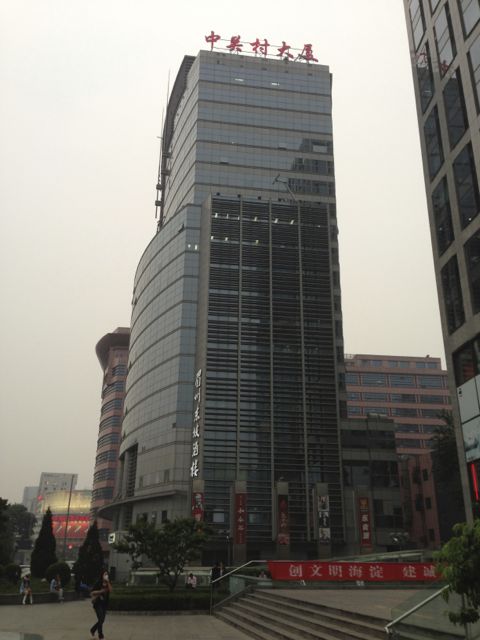
As a teenager in the early 1980s, I visited a number of communist countries: East Germany, Poland, Czechoslovakia. So I find it easy to imagine what Beijing would have looked like before 1978. In mere 30 years, a run-down and crumbling place was transformed into a modern city, which is far better developed than any city I have seen during my visits to formerly communist Ukraine in 2004 and 2009. Also in relation to Rio De Janeiro, Beijing seems newer, and lot cleaner especially compared to the outskirts of Rio.
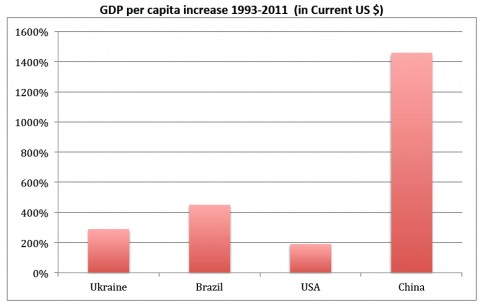
Simple statistics on GDP per capita reveal the economic strength that allowed China to turn Beijing into a world-class physical structure. Between 1993 and 2011, GDP per capita increased almost 15 times in China compared to only 5 times in Brazil, 3 times in Ukraine and 2 times in USA. (Source: Worldbank) Since 1980, China’s GDP per capita has increased 30 times. In the entire recorded history of the world, I don’t know that any other country or region has experienced such a long period of sustained economic growth. It is dazzling to see how the center of Beijing looks similar to the most advanced metropolis in the world. When you travel to the capital of Ukraine, Kiev, you also see luxury cars everywhere, but the infrastructure cannot compare to what exists here in Beijing. In Kiev many roads have potholes and are poorly maintained because the government is unable to collect taxes for infrastructure investments. The Chinese government has other problems, but getting modern infrastructure built is not one of them.
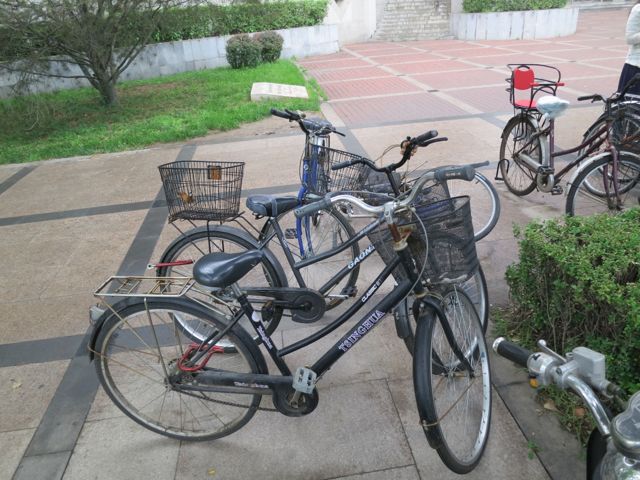
It takes me a couple of days to notice that by Western standards bicycles in Beijing are quite beaten-up and old. I remember that under communism bicycles were perhaps the chief mode of transportation for most Chinese. In Beijing, I have not seen new mountain bikes that have become ubiquitous in Europe and America. Here is a representative photo I took of the typical bicycles.
After being here for a few days, it is obvious that cars and smartphone are the objects around which status competition takes place in Beijing—not bicycles. Virtually every person has a smartphone. I have to look very hard to find someone with regular phone. When I do a bit of research on the web, the statistics bear out what I am seeing on the streets. China is already the largest smartphone market in the world. I am also not surprised to learn that China has become the second largest market for luxury cars behind the USA.
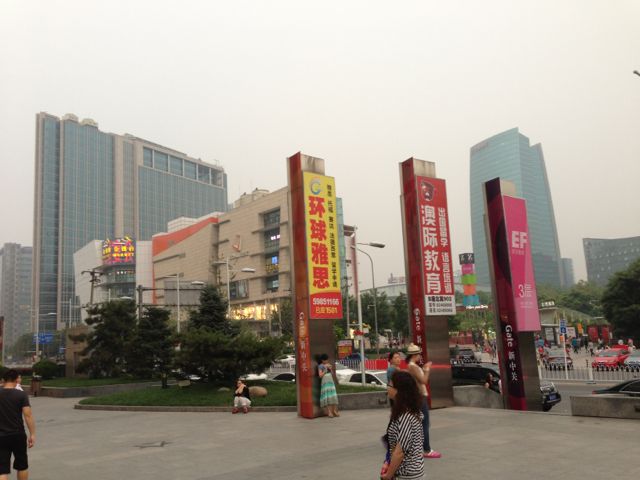
One evening I take a ride on the subway that was built in preparation for the Summer Olympics in 2008. Because the government was afraid of a possible terrorist attack during this mega sporting event, it installed security equipment that we are used to in the West at airports. Even today every person and every bag is screened before you can enter the Beijing subway. I get out on a square not far from the headquarters of Lenovo. Again I am amazed how advanced this city is. Here you can see some of the architectural marvels that were constructed in Beijing during past decade: Beijing Building Gallery.

The next day, I am invited to a private apartment in a residential area. The high-rise building was constructed in the early 1990s. The entry area to the building reminded me of the living quarters I saw in Eastern Europe three decades ago.
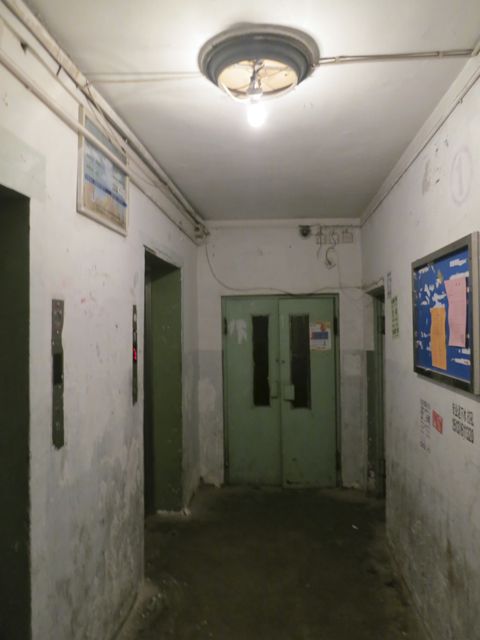
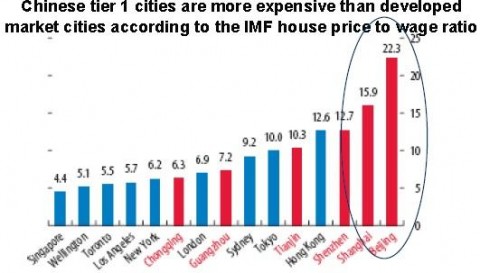
Inside the apartment looked much nicer because it had been cared for. Getting all tenants to agree to upgrade the communal part of the building is much harder. In recent years, the city government often tries to have entire blocks of old buildings demolished to make room for modern developments. Here is a series of photos from all over China that shows these transformations of neighborhoods. Building Modern China Photogallery. The incentive for tearing down entire blocks is the booming real estate market. I am told that the apartment has tripled in value over the past decade. I am surprised to learn that real estate here is becoming more expensive than even Sydney, which is one of the most expensive cities I know. In relation to income of the average worker, Beijing is now the most expensive real estate market in the world as you can see in this graph.
Given I am in Beijing for a workshop and meetings with professors, I don’t have much time for sightseeing. One of the academics I meet convinces me that with only one day left I should see the Great Wall rather than the Forbidden City. He offers to drive me to the Great Wall, which is about two hours outside the center of Beijing. After driving in the city for 90 minutes, we finally hit the countryside. The day turns out to be so foggy that we cannot see more than 50 meters on the Great Wall. I had no idea that we would hike for 4 km on the Great Wall, sometimes quite steep and slippery stone stairs, instead of simply looking at it from nice location. In the USA, much of the wall would have be closed down because walking on it is too dangerous for the average visitor. You really climb up and down the Great Wall and get a sense how medieval soldiers would have prevented people from getting over the wall. Despite the bad weather, it is worth spending my last day visiting this monumental structure. I now understand why all the foreign dignitaries are taken here. Because there are so few white people visiting the Great Wall on this day, I become a small celebrity. A group of four Chinese ladies cannot resist asking me if they can take a photo with me as we climb down the wall. I oblige.
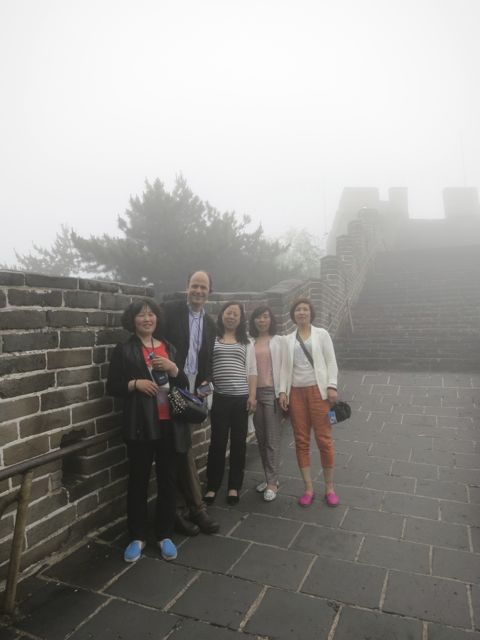
Since we cannot take a good photo of the surroundings of the Great Wall on this cloudy day, I purchase a fake photo at the exit of the Great Wall Tour that is created in the the way Hollywood puts background in a scene shot in a studio. Since power lines don’t reach here, it is not clear whether the outfit is approved by the government or if it is an example of the rampant entrepreneurship in China. The computer that makes this doctored photo is powered by a small power generator, humming in the background while we are waiting for the photo to print out.
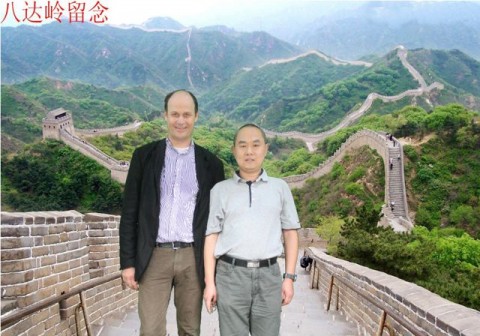
Close to the parking lot is a round cinema that shows a film featuring the different places along the 8,851.8 km (5,500 miles) long historical wall. The structure reminds me of the Cyclorama in Gettysburg, PA. Here in the vicinity of Beijing the land is hilly and green, but the Great Wall also passes flat desserts. Historically, it is symbol of China putting enormous energies into trying to wall itself off from the outside world to keep the “Barbarians” out. Today China is trading with the entire world and is open to foreign ideas except when it comes to political system. The more I learn about China, the more I realize what a courageous decision Deng Xiaoping made when in the late 1970s he decided to send thousands of young people abroad to study at Western universities and bring back to China advanced Western knowledge. It must have been obvious to Deng that they would not only bring new scientific ideas back to their homeland. East Germans at the time wanted to go to West Germany and beyond. Their government walled them off from the West while China broke with traditional communism and embarked on the great social experiment of our time.
It is quite remarkable how every person that I meet is thinking about how they can make more money. The desire to get rich seems more widely shared in this society than in Australia or Germany. Most business ventures don’t work and this is also true in China. But the Chinese who I meet seem to have amazing tolerance for uncertainty and change. I will come back to this in a future letter from China in which I will describe the big changes in the Chinese higher education system.
Beijing is also “breathtaking” in a literal sense. We have all heard about Beijing’s smog problems in the context of the Olympics a few years ago. To make the air quality better during this sport event, the Chinese government simply forced the shut down of dirty plants around the capital. But I was unprepared for how bad the air quality would be. There was only one day when I did not feel I was in the middle of an environmental disaster. During my entire seven days in Beijing, I saw the bright sun not covered up by brown smog for two or three hours. This was the typical view from my hotel room:
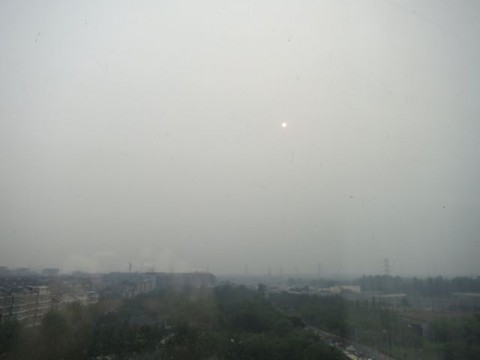
Sometimes when I walked in the streets, I felt like breathing in small little particles of dirt. A few people were wearing a mask. I did some research on smog levels in Beijing and found objective evidence for how bad the air pollution was during my stay in the first week of June. Nowadays you can get up-to-date pollution data on the web and on your smart phone.
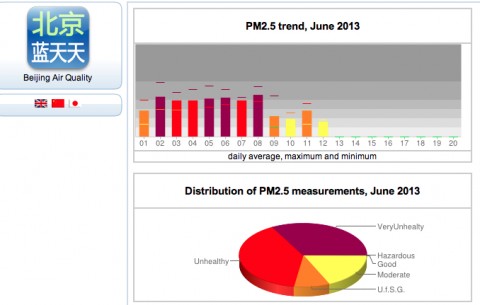
As you can see on the graph charting the week of June, the air was unhealthy or very unhealthy during my entire stay. The air pollution has multiple sources: old coal-based power plants, dirty factories, and the millions of cars that are now populating the roads of Beijing. Every year there are more cars on the road because the capital has about 20 million official residents (those who have a residency permit) who can increasingly afford cars. It is estimated, however, that there are another 20 million people who have moved to Beijing from the countryside and who are tolerated in Beijing but don’t have many of the social services that legal residents enjoy. Last year there were 5 million cars registered in Beijing, causing endless traffic jams and air pollution.
I met a professor from Germany who is leaving Beijing because his respiratory system cannot cope with the pollution. Apparently, many western multinational companies have difficulty getting their employees to accept an assignment in Beijing because they are not willing to move their families to Beijing. During my week in Beijing, I got a much deeper appreciation for the value of clean air that we are now used to in the West. A few months ago, the American National Academy of Sciences published a paper showing that, because of higher levels of air pollution in the North, residents in the Northern part of China have a life expectancy that is 5.5 years shorter than in the South. Even the Chinese who have a higher tolerance for bad air are starting to demand that their government should do more to reduce pollution. Earlier this year there was a chemical spill in a dye factory in Shanxi. When the local government downplayed the problem, there were prolonged protests picked up by the international press.
Because of the one-child policy that came into effect in the 1970s, four grandparents often only have one grandchild. Who wants to see their only grandchild grow up with hazardous air quality? So the government is facing increasing pressure from the Chinese people to protect their health by lowering the levels of pollution. One Chinese professor who received his Ph.D in the West explained to me:
In Western political science terms, the communist party penetrates civil society much more than a party would in the West. But Chinese society also deeply penetrates the communist party. What this means is that when the public does not like what the party is doing, the party experiences tremendous pressure to change course.
If the government would not respond to popular demands to control pollution, it could undermine the legitimacy of the one party rule. There is evidence that the Communist Party is taking the popular concern increasingly serious: Not long after I left Beijing the joint venture that produces BMW cars in Beijing did not get approval to enlarge its factory for environmental reasons. Similarly, the Shanghai municipal government has banned battery makers from the city. The New York Times recently reported many new steps that the Chinese government wants to take to reduce pollution. For China the challenge is that when the West started to clean up its air pollution problems (I can still remember a brown cloud hovering over Los Angeles), GDP per capita figures were higher than they are now in China. For this reason, the Chinese government feels that it needs to strike a delicate balance between enabling economic growth and reducing pollution. I left Beijing with a deeper appreciation for the complex trade-offs the Chinese government must consider. The situation of the leadership struck me a bit analogous to crew of pilots trying to upgrade a Boeing 737 to a much larger and more sophisticated Boeing 777 while in the air. Modern airplanes are developed and assembled on the ground and not while transporting passengers. And the workers and engineers who put them together at least have a reliable blueprint what worked before!
When I announced my Letters from China, I wrote that I wanted to become more knowledgeable about whether China will become the world leader in high-tech industries and if so how. I asked every person I met in China for examples of innovative Chinese companies that are not simply copying innovations made abroad but that are pushing the frontier of global knowledge. Stay tuned for my next letter from China, which will focus on what I learned about early signs that China will produce truly innovative products and services.
Return to Categories: China |
Posted on Oct 02, 13
China
Entrepreneurship
Innovation
Economics
Management
Psychology

